-------------------------------------

7 Fashion Tasks AI Can Do (And 5 It Still Can't)

Jul 9 / Milan Fashion Campus

Key Takeaways

Next, here’s the quick version to keep you focused before you get into tools, examples, and workflows.

  • AI can save hours across the fashion pipeline when you give it clear inputs and constraints like target customer, price point, fabric limits, and a 5-step timeline for a drop

  • It works best on research, ideation, content, and operations, like summarizing trend notes in 10 minutes, generating 20 concept directions from a moodboard description, writing product copy drafts, or turning meeting notes into a to-do list

  • It fails when the work depends on the physical world, like fit, tactile quality, and production accountability, because models cannot feel fabric, pin a sample, or own the cost of a late delivery

  • If you do one thing, keep the workflow human-led: use AI for first drafts and comparisons, then have a designer, merchandiser, or production lead make the final calls on taste, specs, and sign-off

When AI feels like a superpower in fashion and when it doesn’t

But the same tool that can draft 15 lines of product copy in 30 seconds can also slip in a wrong fabric claim, a made-up sustainability detail, or a tone that sounds nothing like your brand. That contrast is the real decision: speed on early-stage work, without letting errors reach customers.

Many teams report saving roughly 20–40% time on early-stage tasks when they treat AI like a first-draft assistant, not a final approver. By the end of this section, you’ll have a simple way to choose what to delegate safely and what must stay human-led.

Where AI helps most: high-volume drafts with low downside

Next, focus AI on work where you need lots of options fast, and where a human can quickly review for fit. The winner here is “blank-page reduction”: getting to something editable in minutes instead of staring at a cursor.

Good places to start include:

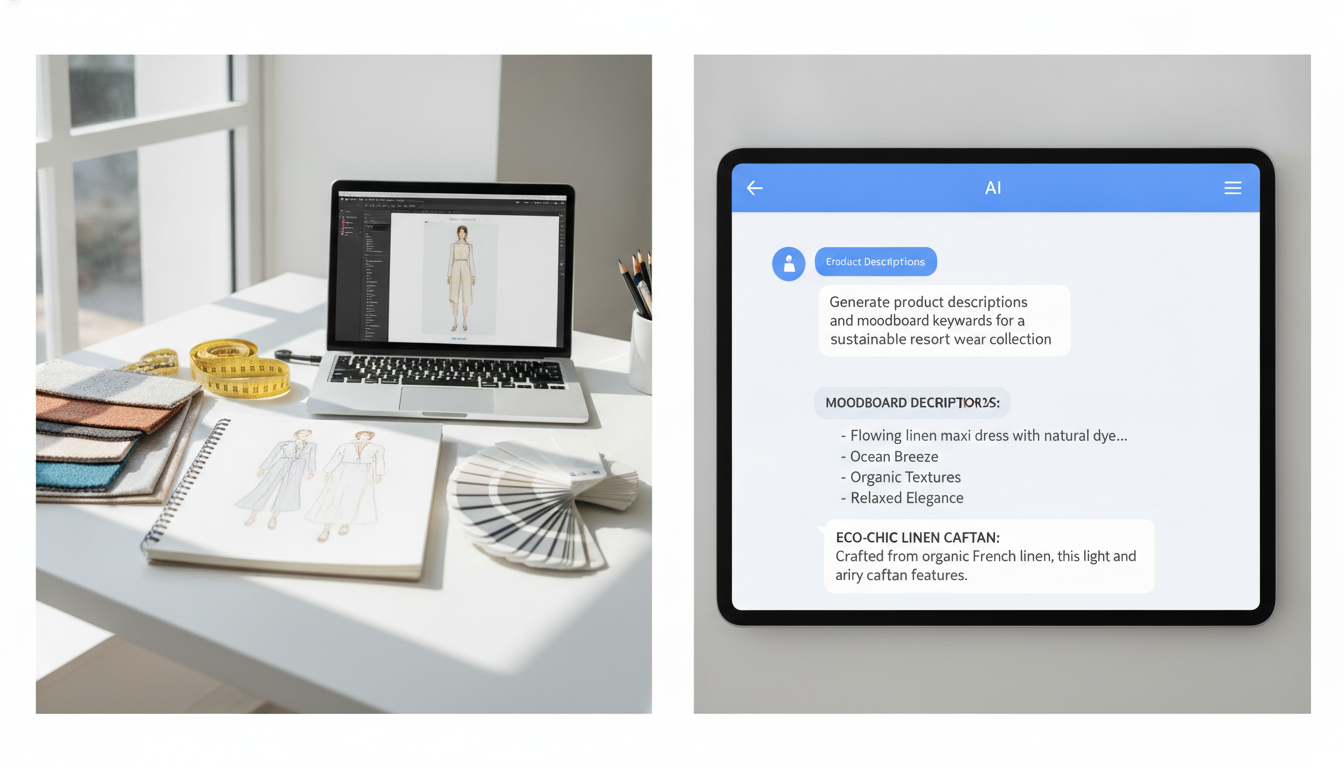
  • Moodboard directions in words (3 different themes, 10 keywords each, plus color pairings)

  • Trend scan summaries from notes you already have (runway notes, store walks, customer reviews)

  • Product and collection copy drafts (5 headline options, 3 descriptions at 60 to 90 words)

  • Email subject lines and SMS variants (10 options, then pick 2 to test)

  • Internal briefs (one-page outline for a shoot, a drop, or a capsule collection)

Tradeoff: this works best when you can supply inputs like your brand adjectives, target customer, price point, and category. It fails when you ask for “new ideas” with no constraints, because the output becomes generic or off-brand.

Where AI breaks down: anything that can harm trust or quality

That said, AI is risky when the task requires truth, tactile judgment, or accountability. In fashion, a small error can turn into returns, complaints, or a screenshot that lives forever.

High-risk areas to keep human-led:

  • Material, care, and fit claims (for example, “100% silk,” “waterproof,” or “runs true to size”)

  • Sustainability and compliance language (anything that sounds like a certification or guarantee)

  • Final product naming and cultural references (higher chance of tone-deaf phrasing)

  • Anything involving supplier terms, pricing, or margin decisions

  • Visual decisions that depend on real drape, hand-feel, and finishing quality

Common mistake: pasting AI text straight into PDPs (product detail pages) or ad copy without a fact check. Fix: require a quick verification pass that compares every claim to your tech pack, fabric certs, and approved phrasing.

A simple delegation rule for fashion teams

So if you do one thing, sort tasks by “reversible” vs “irreversible.” Reversible means you can edit in 5 to 10 minutes and nothing customer-facing breaks if the first draft is messy. Irreversible means one wrong line can damage trust, get you flagged, or create costly rework.

Use this quick check before you delegate to AI:

  • Is the output customer-facing as-is

  • Does it include facts (materials, certifications, country of origin, care)

  • Would a mistake cause returns, policy issues, or reputational harm

  • Can a teammate review it in under 10 minutes with a clear source of truth

If you’re short on time, skip using AI for final claims and sizing notes. Use it for option generation instead, then have a human write the final 3 to 5 lines that must be correct.

The 7 fashion tasks AI can do reliably with the right prompts

Next, here’s the practical line: AI is reliable when the task has clear inputs and you can judge the output fast. Think 30 to 60 minutes saved on first drafts, research summaries, and option sets, then 10 to 20 minutes of human editing to make it sound like you and fit your product reality.

If you do one thing, do this: give AI the same kind of brief you would give a junior teammate. Include the customer, product constraints, price tier, materials, season, and the channel you are writing for (PDP vs email vs Instagram), then ask for 3 to 6 options so you can pick and refine.

  • Trend and competitor synthesis

    • Paste 5 to 10 competitor product links or short notes and ask for a 1 page comparison: silhouettes, fabric claims, price bands, color stories, and repeating phrases

    • Works best when you supply the sources and the time window (for example, last 90 days)

    • Common mistake: asking for “the latest trends” with no inputs, which often returns generic ideas

  • Moodboard directions (words first, visuals second)

    • Ask for 3 distinct mood directions with: keywords, color palette names, fabric textures, and styling notes for a specific customer and occasion

    • If you are short on time, skip images and request “search terms and art direction notes” you can hand to a designer or use in your own tools

  • Naming concepts

    • Generate 30 to 50 name options for a capsule, a drop, or a hero piece, then filter by rules you set (max 3 words, easy to pronounce, fits a minimalist brand)

    • Works best when you provide brand tone examples and words to avoid (for example: avoid puns, avoid luxury coded terms)

  • Collection theme variations

    • Start with one theme and ask for 5 variations that keep the same customer promise but shift the angle (for example: “coastal workwear” becomes “harbor utility”, “salt air city”, “weekend dock to dinner”)

    • Here’s the catch: AI can make lots of options, but you still choose what is true for your brand and feasible for your supply chain

  • Product descriptions (PDP first drafts)

    • Provide a spec snapshot (materials, fit, key features, care, made in, size range) and ask for:

      • 2 versions in your brand voice

      • A short bullet list for skimmers

      • A 1 sentence benefit line for ads

    • Tradeoff: great for structure and clarity, weaker when the spec is missing or the fit details are nuanced

  • Email drafts and campaign angles

    • Ask for 3 email angles for one launch (for example: craftsmanship story, problem solution, limited color drop), each with subject lines, preview text, and a clear CTA

    • Common mistake: letting AI write without your offer details, which leads to vague copy that does not sell

  • Social captions and SEO outlines

    • For social: request 10 caption options across formats (hook, story, how to style, FAQ) sized to your channel (for example, 150 to 220 characters)

    • For SEO: request an outline with H2s, FAQs, and internal link suggestions based on your product category and customer questions

That said, reliability comes from your prompts and your checks, not from “better creativity.” A fast quality check is to scan for fit accuracy, material claims, sizing language, and anything that could create returns or compliance issues, then rewrite the first and last line so the voice is clearly yours.

A simple workflow that works for a solo founder, merchandiser, or junior marketer is: prompt, pick, edit, then store the winning prompt as a reusable template. After 2 to 3 launches, you will have a small prompt library for descriptions, email angles, and naming that stays consistent with your brand.

The 5 fashion tasks AI still can’t do well and why it matters

But once you move from ideas to actual product, the gaps show fast.

AI can help you write a tech pack draft or generate options, but it still struggles with the parts that depend on real materials, human judgment, and accountability.

  1. Fit on a real body (not just in a sketch)

AI can suggest measurements, size charts, and grading rules, but it cannot confirm fit the way a live fitting can. A 1 cm change at the waist can be the difference between “keeps returning” and “customers reorder,” and that only shows up when someone tries it on.

Works best when you already have a proven block pattern to start from. Fails when you are developing a new silhouette, a new size range, or a high stretch fabric where ease and recovery change everything.

  1. Drape and movement in motion

Drape is how fabric hangs and moves, and it is affected by weight, weave/knit, bias direction, and even the seam finishes. AI can mimic a look in an image, but it cannot tell you whether a skirt will twist when walking or whether a sleeve will collapse once it is lined.

Common mistake: approving a design based on a render that looks “flowy.” Fix: require at least one physical sample or a known fabric substitution with a recorded drape outcome from past styles.

  1. Comfort and fabric hand-feel

“Hand-feel” is how the fabric feels in your hands and on skin, including softness, stiffness, itch, and cling. AI can describe fabric properties, but it cannot feel that a rib knit scratches or that a coated fabric gets hot after 20 minutes.

If you do one thing, do this: keep a small in-house fabric library with notes like “soft on skin,” “sheers under flash,” and “pills after 5 wears,” then feed those notes into your prompts instead of generic fabric names.

  1. Quality control without physical sampling and expert review

Quality control is not only “is it sewn.” It is seam consistency, stitch density, needle damage, shrinking, shade matching, print alignment, and whether trims survive wear and wash. AI can generate a checklist, but it cannot spot that a zipper waves on-body or that topstitching tension varies across a batch.

If you’re short on time, skip trying to automate inspection with AI and instead tighten two checkpoints: pre-production sample approval and a short inline check early in the run (before most units are completed).

  1. Original brand taste, cultural context, and accountability

AI can remix what already exists, which is useful for ideation, but it does not own a point of view. “Brand taste” is the consistent set of choices you make, like proportion, color restraint, trim preferences, and what you refuse to ship even if it sells.

Here’s the catch: AI also cannot take responsibility. If a print references a culture in a careless way, or if a production decision conflicts with your ethics claims, the accountability is on your team, not the tool. That is why final calls on messaging, references, and production tradeoffs should stay with a named human owner (designer, merchandiser, or production lead).

How to use AI without losing your brand voice and product quality

Next, the goal is to get speed from AI without letting it quietly rewrite your brand into something generic. A common failure mode looks like this: a merchandiser pastes a product page into a chatbot, publishes the rewrite in 10 minutes, and customer support gets returns because the fit and fabric claims are now vague or slightly wrong. A practical benchmark is to aim for at least 80% of your final copy being approved as-is on the first human pass, otherwise your prompt and guardrails need tightening.

If you do one thing, make AI work inside a repeatable workflow that forces clarity early and adds human judgment at the right moments.

A simple workflow you can run every time

So treat AI like a junior writer: fast at drafts, not accountable for accuracy. This workflow keeps quality high even when you are producing 20 product descriptions, 10 email subject lines, or a full drops calendar in a week.

  1. Brief (2 to 5 minutes)

  • What is the item, customer, and goal (sell-through, education, preorder)

  • Where the copy will appear (PDP, email, TikTok caption)

  • What must be true (exact materials, care, size range, pricing info)

  1. Constraints (1 to 2 minutes)

  • Brand voice rules (for example: short sentences, no hype words, no slang)

  • Reading level (for example: keep sentences under 20 words)

  • Compliance notes (country of origin language, claims you cannot make)

  1. First draft (AI, 1 to 3 minutes)

  • Ask for 2 to 3 options, not 10

  • Ask it to show assumptions separately so you can delete them

  1. Human critique (5 to 10 minutes)

  • Accuracy check against your source of truth (tech pack, line sheet, lab results)

  • Voice check against 2 existing brand examples

  • Risk check (returns risk, fit confusion, sensitive wording)

  1. Revision loop (AI + human, 1 to 2 rounds)

  • Feed back specific edits, not general feedback like “make it better”

  • Stop after 2 rounds if it is drifting, then rewrite the tricky lines yourself

  1. Final sign-off checklist (30 to 60 seconds)

  • Every claim is supported by internal data

  • The first 2 lines say what it is and why it matters

  • No invented sustainability or performance claims

  • Sizing and care language matches your standard terms

  • Tone matches your brand samples

Guardrails that protect voice, originality, and trust

That said, guardrails only work if they are specific and enforced. AI works best when you give it clean inputs and tight boundaries, and it fails when you paste messy notes and hope it “figures it out.”

Data you won’t share (set this once, then repeat it in prompts)

  • Unreleased collection details (drops, supplier names, cost sheets)

  • Customer personal data (addresses, order history, support tickets)

  • Contract terms, factory audit notes, and internal margin targets

Originality and plagiarism checks

  • Never ask AI to “write like” a competitor or a specific creator

  • Run a quick plagiarism scan on long-form copy, especially blog posts and lookbook stories

  • For PDPs, also scan for phrases that sound like common marketplace templates and rewrite them in your own words

Bias checks (plain-English version: avoid unfair or stereotyped language)

  • Watch for default assumptions about body type, gender, age, or “professional” style norms

  • If you describe fit, anchor it to measurements and garment behavior, not judgment words

Approval points by role (keeps speed without losing accountability)

  • Designer or product developer approves materials, construction, and care language

  • Merchandiser or ecom lead approves naming, pricing context, and category consistency

  • Brand or creative lead approves voice and campaign alignment

  • Customer support lead sanity-checks return-risk wording (fit, sheerness, stretch, shrink)

If you’re short on time, skip the extra AI revision rounds and do this instead: one careful human critique pass plus a signed checklist. It is faster than fixing a week of inconsistent copy after it is already live.

Closing remarks

Tools don’t replace taste, they amplify it. If you already know what “good” looks like for your brand, AI can help you get to a strong draft faster, test more options in an hour, and spend more time on the final 10% that customers actually feel.

Next, pick one task to automate first this week, ideally something repeatable and low risk such as first-pass product descriptions, size chart formatting, or a batch of outfit caption ideas. Then set a firm human-only boundary where you will always step in, like final fit and fabric calls, selecting hero images, or deciding what ships and what gets cut.