
-------------------------------------

Business Styling for Job Interviews and Professional Image

Jun 28 / Angelo Russica

Key Takeaways

  • Business styling helps clients communicate credibility and confidence in interviews and professional settings

  • A professional image consultant translates role, industry, and personality into a clear wardrobe plan

  • The best results come from intention, fit, grooming, and a repeatable system clients can use

When your client has the skills but their outfit undermines the message

Next, picture a client who has the right experience, answers clearly, and has a solid resume, but they walk into the interview in a jacket that pulls at the buttons, scuffed shoes, and hair that looks like they rushed. In the first 10 seconds, the interviewer is already clocking fit, grooming, and overall polish, long before your client gets to show their strengths.

Heres why it matters: when the look signals “unprepared” or “not detail-oriented,” the client has to spend the rest of the interview proving the opposite. Your job as a stylist is to make the visual message match the spoken message, so the interviewer can focus on the client’s skills instead of their hemline or shine level.

If you do one thing, start with fit and grooming before you chase trends or brand names. Fit reads as competence in nearly any office setting, while grooming reads as respect for the room.

A simple client process you can repeat in 30 to 45 minutes:

  • Ask for the role, level, and work setting (bank branch, hospital admin, tech sales, legal assistant)

  • Get a quick “dress code snapshot” by checking 10 to 15 employee photos on the company site and LinkedIn

  • Choose one outfit formula that matches that setting (for example, blazer plus tailored trousers plus closed-toe shoes)

  • Do a fast fit check: shoulder seams, sleeve length, pant break, waist gaping, collar sit

  • Do a grooming check: hair, nails, lint, wrinkles, shine on shoes, bag condition

  • Build one backup option in case the client spills coffee or the room runs warm

Heres the catch: this works best when the client can try items on in good lighting with the right undergarments and shoes. It fails when you style from photos only and discover on interview day that the blazer rides up or the shirt goes sheer.

If youre short on time, skip building multiple outfits and focus on one interview-ready base look plus one swap (for example, a second top). A common mistake is over-accessorizing to “look polished” and ending up distracting. The fix is to keep accessories to one focal point and make everything else quiet and consistent.

Define business styling and the message the client must send
Next, stop thinking in outfits and start thinking in message. If you do one thing first, define what “credible” means for this role, at this company, in this location, on this interview format (video vs in-person). A candidate for a finance analyst role may need a quieter, more traditional signal than a UX designer interviewing at a startup, even if both are equally qualified.

Clarify the goal with a short prompt set you can run in 10 minutes:

  • Role expectations: What does “ready on day one” look like in this job

  • Company culture: Formal, business casual, client-facing, or production floor practical

  • Personal brand: The 2 to 3 words the client wants remembered (for example: reliable, calm, detail-focused)

  • Credibility benchmark: What the hiring team expects to see at first glance (for example: polished grooming, consistent fit, minimal distractions)

Also, map the image pillars so every choice supports the client instead of stealing attention. This works best when you keep the pillars simple and repeatable across 2 to 3 interview looks; it fails when you chase trends or add statement pieces to “stand out.” If you’re short on time, lock in silhouette + color first, then fix grooming.

Use these five pillars as your checklist:

  • Silhouette: Fit and structure that match authority level (for example: tailored blazer vs slouchy overshirt)

  • Color: A controlled palette of 2 to 3 core colors plus 1 accent (for example: navy, white, charcoal with a muted blue)

  • Fabric: Materials that read intentional on camera and in daylight (avoid shiny, clingy, or easily wrinkled fabrics)

  • Grooming: Hair, skin, and nails that look consistent up close (especially on video calls)

  • Accessories: Quiet, functional pieces (keep jewelry minimal; let one item lead, not five)

A common mistake is treating accessories as the “personality” layer when the base look is still unsteady. Fix it by getting fit and grooming right first, then adding one controlled brand detail, like a simple watch, a structured bag, or a single color accent.

Run a job interview styling process that works every time

Next, keep your interview styling consistent by using the same short intake every time. When you skip this, you fall back on personal taste and your client walks into a panel interview looking “nice” but not right for the role.

Start by asking questions that shape the target look fast:

  • Industry and company type (bank, nonprofit, early-stage startup)

  • Role and seniority (intern, individual contributor, manager, director)

  • Expected dress code (business formal, business casual, “no dress code”)

  • Confidence colors (the 2–3 colors they feel strongest wearing)

  • Best-fitting garments (one blazer, trouser cut, or dress that always works)

  • Distraction risks (noisy jewelry, tight waistbands, slipping straps, visible logos)

If you do one thing, get the dress code and seniority clear in the first 3 minutes. A navy suit can read “ready for client meetings” in one office and “too corporate” in another, and the same outfit can land differently for a junior role versus a team lead.

So, once you know the target, build an outfit formula your client can repeat for any interview round. This works best when the pieces are predictable and comfortable; it fails when the outfit needs constant adjusting or the shoes cannot handle a 10-minute walk from parking.

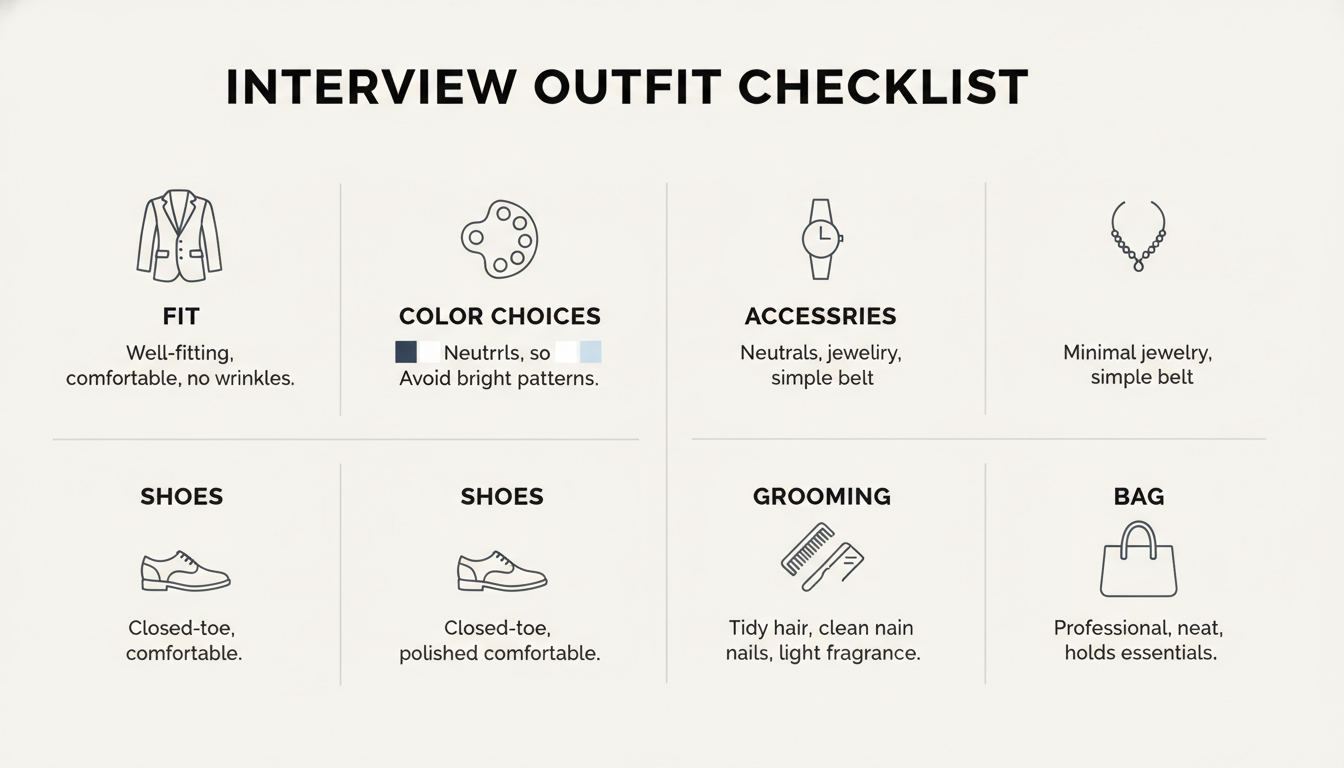
Use this quick formula to assemble the final look:

  • Clean lines: one main layer (blazer or structured knit) with minimal visual noise

  • Comfort: enough ease to sit for 45–60 minutes without pulling or fidgeting

  • Correct fit: shoulders sit flat, hems finished, waistbands stay in place

  • Polished shoes: clean uppers, stable heel height, broken in before interview day

  • Edited accessories: 1–2 pieces max, avoid sparkle, sound, and statement branding

  • Ready-to-wear grooming: hair secured, nails neat, light scent or none, lint-free fabrics

  • Bag: structured tote or brief-style bag that fits essentials without bulging

If you’re short on time, skip shopping and focus on fit and grooming: steam the outfit, swap to the most polished shoes they already own, and remove one accessory. Those three changes often improve the “put together” signal in under 30 minutes.

Fix the common mistakes that cost clients confidence and credibility

Next, fix the issues that clients feel the moment they look in the mirror, because confidence drops fast when something looks “off,” even if they cannot name why. A quick check can save 20 to 30 minutes of second-guessing before an interview, on-camera meeting, or first day in a new role.

Diagnose fast with this credibility checklist:

  • Overdressing: a suit that reads boardroom when the role is casual office

  • Underdressing: missing structure, polish, or a clear “work” signal

  • Wrong-industry cues: creative details in a conservative field, or vice versa

  • Poor fit: pulling at buttons, collapsing shoulders, too-long sleeves, too-wide trousers

  • Wrinkles and shine: rumpled cotton, crushed linen, lint, visible deodorant marks

  • Noisy prints: high-contrast patterns that dominate the face on video

  • Neglected shoes and bag: scuffed toes, worn heels, peeling edges, overstuffed totes

That said, fixing mistakes does not mean putting every client in the same corporate uniform. If you do one thing, keep the client’s identity and remove the distractions.

Preserve identity by refining personality with controlled accents:

  • Pick one signature element (a color, a neckline, a jewelry style, a tailored jacket shape)

  • Keep accents to one or two items per outfit so the message stays clear

  • Match the accent to the job signal: for example, a subtle color pop for marketing, a quieter texture for finance

  • If you’re short on time, skip “perfecting” accessories and focus on fit, fabric condition, and shoes

Common mistake: copying a generic executive look that fights the client’s personality, so they feel like they are in costume. Fix: ask what they want to be remembered for in 5 seconds, then build the outfit so everything supports that one line.

Closing remarks

So when you help a client dress for work, you are not picking “nice clothes.” You are making sure their outfit supports what they want the room to believe in the first 30 seconds.

Professional image is not about pretending. It is about showing up with intention.

Next, ask one question before you shop, tailor, or build a lookbook: what professional moment does your client have next, and what message must their outfit support?

Explore styling courses to build professional image consulting skills

Next, if you want to move from “good eye for outfits” to a repeatable client service, structured training helps you stop guessing and start working from clear steps.

Milan Fashion Campus offers several styling paths that match common image consulting goals, from personal wardrobe work to editorial shoots. You can learn online at https://academy.milanfashioncampus.eu/ or join in-person experiences in Milan at https://www.milanfashioncampus.eu/

Here are a few course directions to consider, based on the kind of clients you want to support:

  • Personal Women Fashion Styling: best if you want to build a core service for professional women, including wardrobe planning and outfit building for work and interviews

  • Combo Women & Men: best if you want to take on mixed client lists, such as couples, executives, or corporate referral work

  • Men Image: best if you want to focus on men’s fit, proportions, and business wardrobe upgrades, for example a manager preparing for promotion interviews

  • Media Editorial: best if you want to work with creative direction, styling concepts, and story-led looks, not just daily wear

  • Photoshoot-based experiences: best if you learn fastest by doing, and want portfolio-ready results such as styled looks captured in a real shoot environment

That said, pick based on your constraint.

  • If you only do one thing: choose the path that matches the clients already asking you for help

  • If you’re short on time: start with one focused track (women, men, or combo), then add editorial and photoshoot work later

  • Common mistake: choosing editorial first when your paid work is job interview styling, then feeling stuck translating concepts into everyday outfits

FAQ

What is business styling?

Business styling is choosing clothing, grooming, and accessories that match a workplace and role. The goal is to remove distractions and support the message you want to send, such as reliable, organized, or client-ready.

What should a client wear to a job interview?

A clean, well-fitted outfit that matches the role’s expected formality. Aim for 2 to 3 neutral pieces, minimal accessories, and comfortable shoes. If unsure, dress one level more formal than the day-to-day dress code.

What does a professional image consultant do?

They translate a client’s goals into a clear visual plan. That can include fit checks, color guidance, outfit building, shopping lists, grooming notes, and interview-day prep so the client looks aligned with the role and industry.

Should interview outfits be formal?

Not always. Formal works best for conservative workplaces, client-facing roles, and leadership interviews. It can fail when it looks out of place for a casual industry. If you only change one thing, match the interviewer’s likely dress code.

Can styling improve interview confidence?

Yes, when the outfit is comfortable and feels like the client. The common mistake is copying a “perfect” look that is stiff or unfamiliar. Fix it by doing a full sit, walk, and reach test before interview day.

Is business styling only for corporate jobs?

No. It applies to healthcare, education, retail management, hospitality, tech, and creative roles. The key is aligning with the job’s expectations, not a corporate stereotype.

What colors are best for professional image?

Start with neutrals that photograph well like navy, charcoal, gray, cream, and soft white. Add one controlled accent color if it supports the message. Avoid loud prints when they pull attention away from the client’s face.

Can online styling courses teach professional image consulting?

Yes, if they include practical exercises like fit evaluation, color analysis basics, outfit formulas, and real client scenarios. If you’re short on time, focus on fit, grooming, and a repeatable outfit checklist first.