-------------------------------------

How Your Face Shape Influences Every Fashion Choice

Jul 9 / Milan Fashion Campus

Key Takeaways

  • Your face shape is a reliable starting point for choosing flattering frames, earrings, necklines, and hairstyles

  • Small proportional tweaks can balance features without changing your personal style

  • A quick face-shape check helps you shop faster and avoid common fit and harmony mistakes

Find your face shape in 2 minutes and stop guessing what flatters you

Next time you try on five pairs of sunglasses and none feel quite right, it is usually not the trend, it is the proportions. A pair can look great on the rack and still feel "off" on you because your face needs balance, not whatever is popular this season.

Most people fall into 6 to 8 common face-shape categories, and one or two usually fit best. The goal here is not to label yourself perfectly, it is to get close enough to make better choices faster.

By the end of this section, you will be able to identify your likely face shape and apply it to eyewear, jewelry, hair, and accessories so you stop guessing in fitting rooms and mirrors.

A quick 2-minute check you can do right now

Also, you do not need special tools to get a useful answer. If you do one thing, do this in good light and with your hair pulled back so your hairline and jawline are visible.

2-minute checklist

  • Stand about an arm’s length from a mirror or use a front-facing camera

  • Pull hair away from your face and remove bulky glasses or hats

  • Look for the widest point: forehead, cheekbones, or jaw

  • Check your jawline: rounded, angled, or pointy

  • Compare face length to width: about equal, slightly longer, or much longer

Common mistake and fix

  • Mistake: judging from one selfie with a wide-angle lens

  • Fix: step back a little or zoom in slightly to reduce distortion

If you are short on time, skip measuring and focus on only two cues: widest point and jaw shape. That is usually enough to narrow you down to 1 or 2 likely shapes.

How to use your result without overthinking it

But face shape is a guide, not a rulebook. It works best when your goal is to create balance, and it fails when you try to force yourself into a single category even though your features are mixed.

Try this simple prioritization: choose style moves that balance your widest area.

  • If your forehead is widest, you will usually prefer styles that add visual weight lower on the face

  • If your jaw is widest, you will usually prefer styles that add width or detail higher up

  • If your face is much longer than it is wide, you will usually prefer styles that add width and reduce vertical emphasis

For example, if two sunglasses feel similar but one makes your face look longer, pick the pair that adds a bit more width. The same logic applies to hoops vs drops, side parts vs center parts, and collar shapes that sit near your jawline.

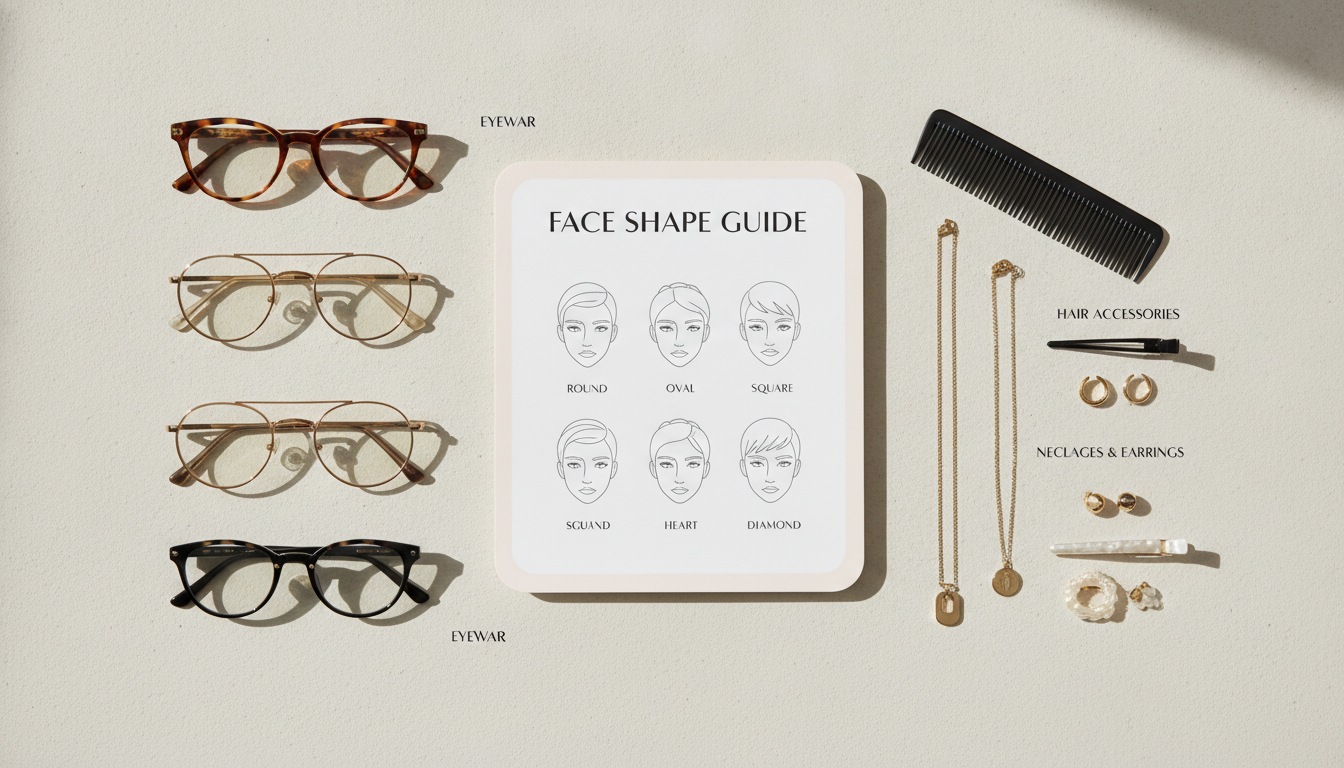
Identify your face shape using simple measurements and visual cues

Next, swap guessing for two quick checks: a few measurements and a quick “visual cue” review. You are not trying to find a perfect match, you are trying to spot your dominant proportions so you can choose frames, earrings, and hairlines that feel balanced.

If you do one thing, measure face length and cheekbone width first. Those two numbers usually tell you whether you read as long vs wide, which narrows the options fast.

What to measure (takes about 2 minutes)

  • Forehead width: widest point across the forehead

  • Cheekbone width: widest point from cheekbone to cheekbone

  • Jawline width: from the tip of your chin to below your ear, then double it

  • Face length: hairline to chin

Use a soft tape measure if you have one. If you do not, use a string and lay it against a ruler.

Also, match the pattern, not the exact numbers. For example, if face length is clearly bigger than cheekbones, you are in the “long” group; if cheekbones and length are close, you are in the “balanced” group.

Common mistake: measuring too low on the jaw and calling your face “square” when it is not. Fix it by measuring from the chin point to just under the ear, where the jaw actually turns.

That said, the two biggest decision drivers are soft vs angular and long vs wide.

  • Soft vs angular: look at your jaw and cheekbones in a front photo. Rounded corners read soft; straight lines and clear angles read angular

  • Long vs wide: compare face length to cheekbone width. If length looks notably longer, you read long; if width competes with length, you read wide

If you are short on time, skip the tape and do the photo check in good light, straight-on, with hair pulled back. You will still get an accurate enough read to make better style choices.

Choose eyewear and sunglasses that balance your proportions

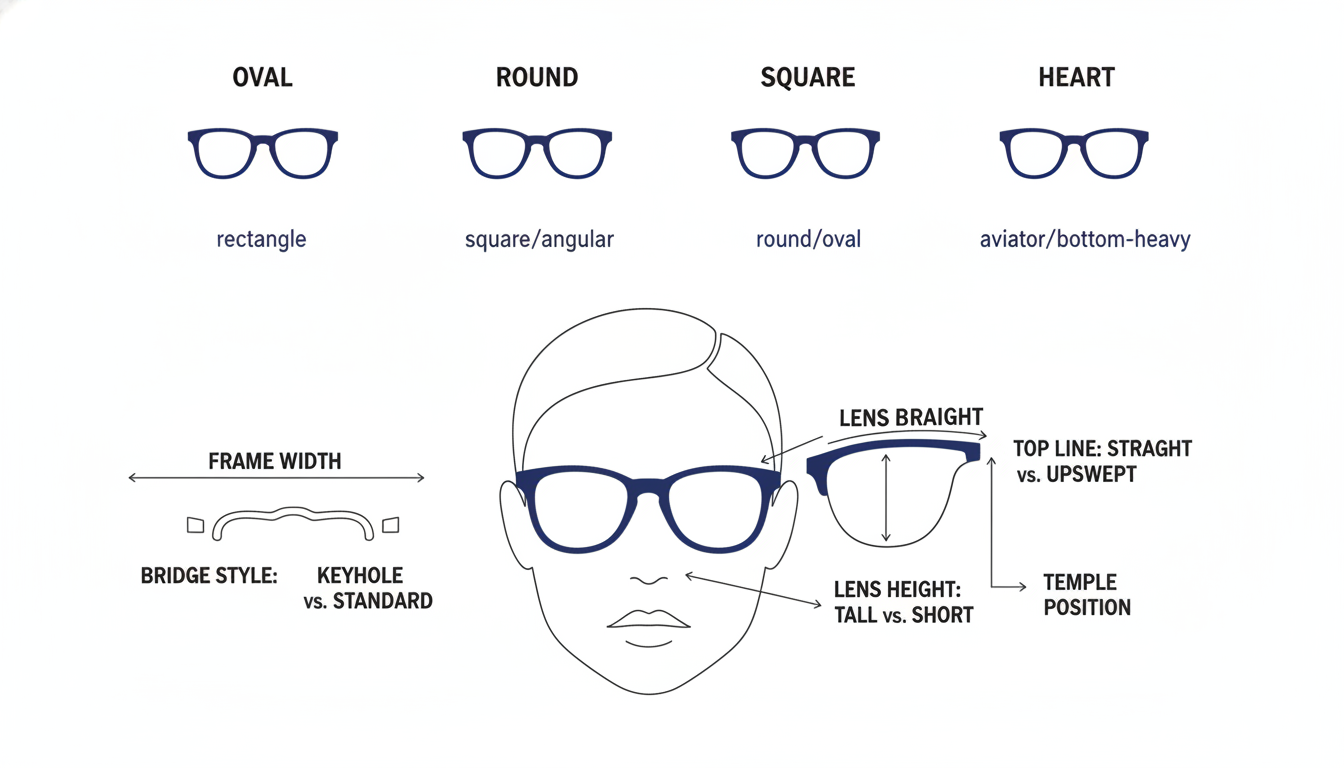
Next, treat glasses like a mini “face framing” tool you wear every day. Start with frame width: the outer edges should land close to your cheekbone width, not noticeably inside it (pinched) or far past it (overpowering).

Once width is right, choose a shape that counterbalances your strongest lines. If you do one thing, do this: pair curves with angles, and angles with curves so your face reads more balanced at a glance.

Here’s a simple way to pick shapes fast:

  • Rounder face, softer jaw, fuller cheeks: try more angular frames (rectangle, square, geometric) to add definition

  • Sharper jaw or strong cheekbones: try rounder or oval frames to soften edges

  • Longer face: try frames with more lens height to reduce the “vertical” look

  • Shorter face: try slightly taller lenses only if they do not cover your brows, otherwise go medium height for balance

Common mistake: picking a shape first and forcing the size. Fix it by choosing width and lens height first, then deciding between 2 to 3 shapes.

That said, the small design details do a lot of the work, especially on camera.

  • Bridge style

    • A keyhole or softer bridge can make a strong nose bridge look softer

    • A higher, narrower bridge can visually lengthen a shorter-looking nose area

  • Top line (brow line) of the frame

    • A straight top line adds structure and can make softer features look sharper

    • An upswept top line can lift the look when your cheek area feels wide

  • Lens height

    • Taller lenses can visually shorten a longer face

    • Shorter lenses can make a face look longer and more streamlined

Tradeoff: bold, thick frames work best when your features can “hold” them (strong brows, defined cheekbones) and can feel heavy when your features are delicate. If you’re short on time, test two extremes in the mirror for 30 seconds each: one bold pair and one light pair, then pick the one that keeps your eyes as the focus.

Style jewelry and hairlines to frame your face, not fight it

Next, use jewelry and your hairline the same way you use glasses: to steer the eye. Small changes here can fix the “something feels off” problem even when your outfit is simple.

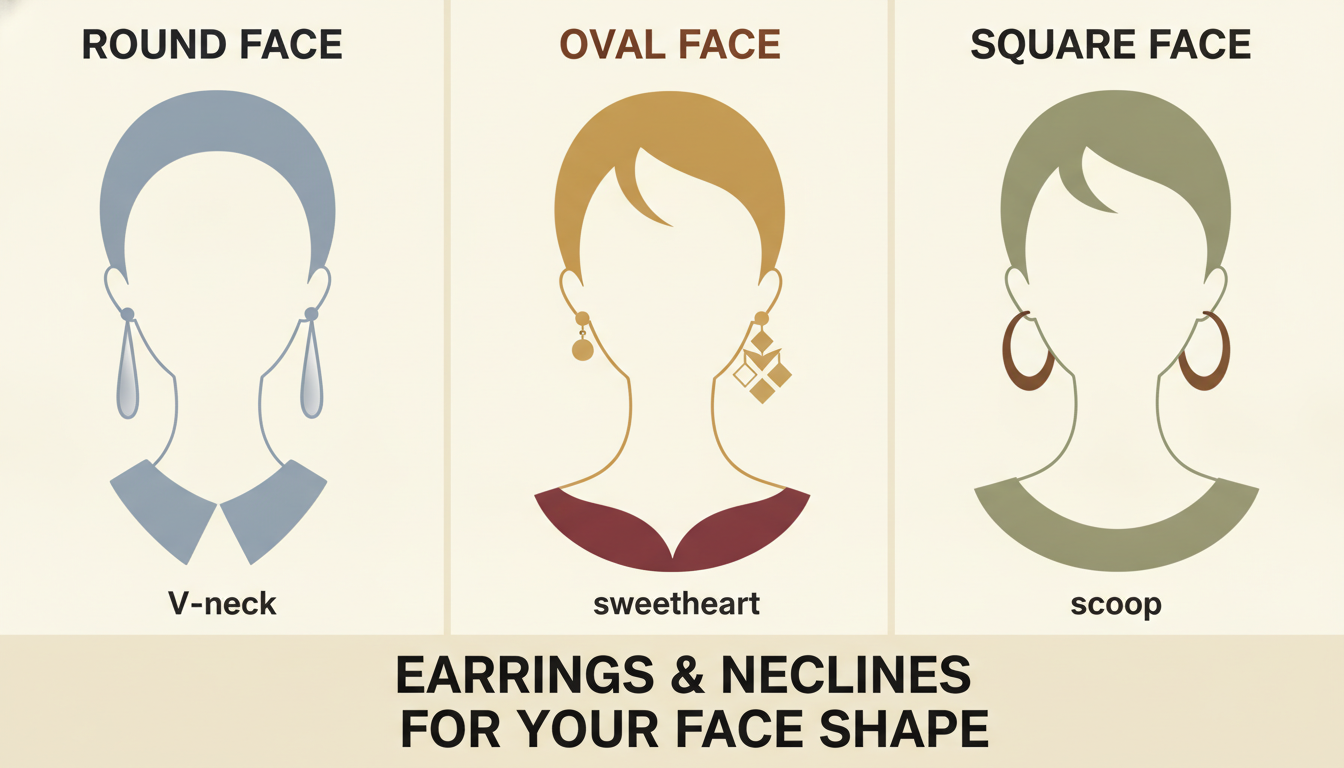
Earrings and necklaces create either vertical or horizontal emphasis, so pick the direction you need more of.

  • If your face reads wider than it is long, try vertical lines: teardrops, slim drops, threaders, and long pendant necklaces

  • If your face reads longer than it is wide, try horizontal lines: hoops, clustered studs, wide chandeliers, short chains, and choker length necklaces

  • If you only change one thing, change the earring shape first because it sits closest to your face

  • Common mistake: matching earrings to a top but ignoring the neckline shape; fix it by pairing V necks with tapered drops and crew necks with hoops or shorter chains

That said, hair parting, bangs, and where you place volume can add structure or softness exactly where you are missing it.

  • Middle parts and straight, even volume can make features feel more symmetrical, which helps when your face looks round or soft

  • Side parts and side swept bangs create diagonal lines, which can break up a strong jaw or a very long look

  • Curtain bangs and cheekbone length layers add width around the mid face, useful when your chin feels narrower than your forehead

  • If you’re short on time, skip a full haircut and just change placement: add volume at the crown for more length, or add volume at the sides for more width

Closing remarks

So here’s the core idea to keep: harmony isn’t about rules, it’s about proportion.

When your frames, earrings, and hairline work with your face shape, small tweaks can change the whole look in minutes.

Which one change will you test first: new frames, different earrings, or a different hair part?


Milan Fashion Campus is an Italian fashion school based in Milan, specialised in short courses that combine updated practical skills with authentic Italian fashion experience. Founded and directed by Angelo Russica — former collaborator of Gianni Versace and consultant for Max Mara, Marzotto Group and Miroglio Vestebene — the school welcomes students from all over the world with a direct, modular, industry-connected approach.