-------------------------------------
Jul 3 / Milan Fashion Campus

Men’s Personal Styling Questionnaire: A Minimal Digital Client Form

Milan Fashion Campus Men's Personal Styling Questionnaire

Milan Fashion Campus

Men's Personal Styling Questionnaire

A Milan Fashion Campus digital client form for men's personal styling consultations, wardrobe review, outfit creation, shopping guidance and the final style report.

Initial Consultation

Lifestyle

Personal Style Goals

Preferred Style

Visual Style Personality Reference

Use these images to help the client identify the style direction that feels closest to his image.

Classic menswear style reference
Classic
Dramatic menswear style reference
Dramatic
Natural menswear style reference
Natural
Elegant menswear style reference
Elegant
Creative menswear style reference
Creative
Modern menswear style reference
Modern

Style Confidence Rating

Body and Image Analysis

Body Shape

Body Shape Visual Reference

Compare the client proportions with the visual examples before selecting the body shape.

Oval body shape reference
Oval
Triangle body shape reference
Triangle
Inverted triangle body shape reference
Inverted Triangle
Rectangle body shape reference
Rectangle
Trapezoid body shape reference
Trapezoid

Preferred Fit

Face Shape

Face Shape Visual Reference

Use these face examples to support decisions about hair, beard, glasses and accessories.

Round face shape reference
Round
Square face shape reference
Square
Rectangle face shape reference
Rectangle
Heart face shape reference
Heart
Diamond face shape reference
Diamond
Oval face shape reference
Oval

Style Personality

Image Impact Rating

Wardrobe Review

Wardrobe Categories

Category Good Needs Update Missing
Suits
Jackets
Shirts
Trousers
Shoes
Accessories

Outfit Creation

Outfit Reference Examples

Use these outfit examples to discuss workwear, casualwear, eveningwear and personal style direction.

Men outfit reference 1
Smart Casual
Men outfit reference 2
Business
Men outfit reference 3
Casual
Men outfit reference 4
Evening
Men outfit reference 5
Streetwear
Men outfit reference 6
Creative

Shopping Guidance

Shopping Experience

Shopping List

Final Digital Style Report

Overall Transformation Rating

The digital report will appear here after clicking Generate Client Report.

Use Copy Report or Download Report after generating the summary.

Use for FREE

Key Takeaways

A client says “I just want to look better,” you hop on a 45-minute call, and you still end up guessing their budget, fit issues, and daily dress code. A short, structured questionnaire fixes that by giving you clean inputs before you talk, so your consultation time goes to decisions, not discovery.

  • A short, structured questionnaire can reduce consultation time while improving the accuracy of styling recommendations

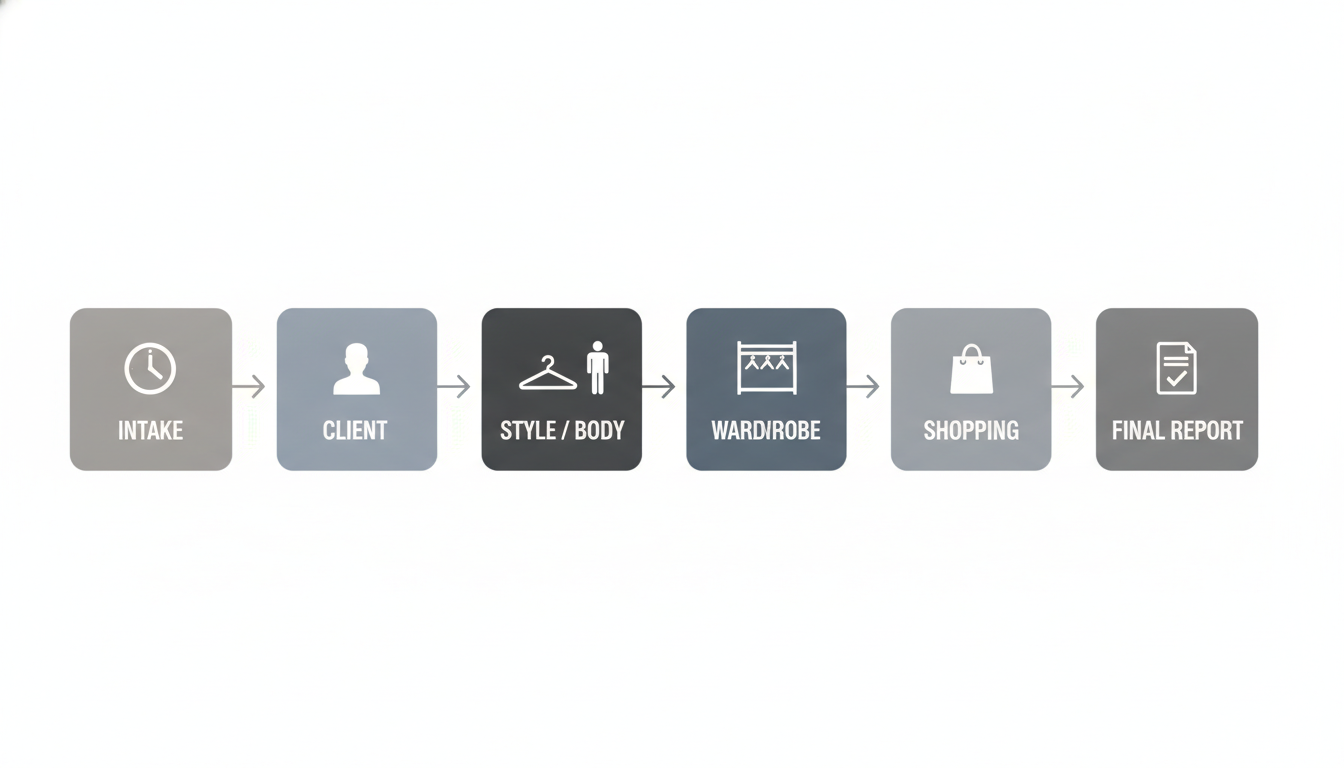
  • Organizing questions by Client, Style, Body, Wardrobe, Shopping, and Report keeps the process consistent and scalable

  • Clear inputs lead to clearer outputs: fewer revisions, better outfits, and a stronger final style report

Get sharper client answers before your first styling call

You hop on a first consult, and 20 minutes disappear into basics like sizing, dress codes, and what they actually need help with. A lean pre-call form can cut that time by about 30–50%, so your live time goes to decisions: outfits, fit, and a plan they can follow.

By the end of this section, you’ll have a simple set of questions grouped into 6 sections and you’ll see how each answer maps to your final style report. If you do one thing, get these answers in writing before you meet, then use the call to confirm and prioritize rather than collect.

The 6 sections to ask about (and what each one improves)

Use these six buckets to keep answers easy to skim and easy to reuse. Works best when you keep most questions multiple choice and limit open-text to 1 to 2 prompts per section; it fails when every question is open-ended and clients write paragraphs you cannot compare.

  1. Client basics (who they are day to day)

  • Role and typical week (for example: 3 days office, 2 days travel)

  • Climate and commute (10-minute walk vs driving)

  • Budget range per item or per season How it supports the report: sets realistic outfit templates and shopping priorities

  1. Goals and pain points (what “better style” means to them)

  • Top 2 outcomes (for example: look more senior, stop overbuying)

  • What is not working now (fit, color, too casual, too dressy)

  • Deadline or event window (for example: “in the next 4 weeks”) How it supports the report: determines the order of recommendations and what you tackle first

  1. Style and body notes (fit and proportions you must respect)

  • Usual sizes and brands that fit best

  • Fit preferences (slim, classic, relaxed) with one example item

  • Areas they want to minimize or highlight How it supports the report: reduces guesswork in silhouettes and helps you write clearer fit rules

  1. Wardrobe reality check (what they already own)

  • What categories are missing (shoes, outerwear, basics)

  • Their 3 most-worn items and why

  • Items they avoid and why (for example: “feels tight at shoulders”) How it supports the report: separates keep, tailor, replace, and prevents duplicate purchases

  1. Shopping behavior (how they buy and what blocks them)

  • Where they shop now (online only, in-store, both)

  • Common return issues (size inconsistency, styling uncertainty)

  • Time constraints (for example: “max 60 minutes to shop”) How it supports the report: shapes store lists, timing, and how detailed your shopping notes must be

  1. Practical constraints (the things that override taste)

  • Dress codes (office, client-facing, uniform limits)

  • Grooming or comfort boundaries (no iron, no dry clean, sensitive fabrics)

  • Must-have practical needs (weather, travel, kids, mobility) How it supports the report: keeps recommendations wearable and reduces drop-off after the consult

Common mistake: asking for “style inspiration” too early and getting vague answers like “classic” or “modern.” Fix it by asking for 3 reference looks and 3 words, then forcing a choice between two opposites (for example: structured vs relaxed) so you can write rules you can apply.

Build the Client section so you can personalize fast

Next, build a Client section that answers the basics you usually end up asking in the first 10 minutes of a call. When you collect these details up front, you can skip generic recommendations and go straight to choices that match their real life.

Capture essentials that change what you suggest:

  • Lifestyle and weekly routine (for example: 3 days in-office, 2 days remote, weekends outdoors)

  • Work dress code and role expectations (client-facing sales vs back-office analyst)

  • Climate and travel (hot summers, cold winters, frequent flights)

  • Timelines (a wedding in 6 weeks, a promotion next month, a photoshoot next Friday)

  • Budget comfort (a typical spend range per item, plus categories they will not spend on)

  • Communication preferences (text vs email, weekday evenings only, prefer 2 options not 10)

If you only do one thing here, make it the success-definition prompt. Ask one question that forces a measurable before/after so you align expectations before you style a single look.

Use a prompt like:

  • "Three months from now, what would make this feel successful? List 3 situations you want to feel ready for, and what you want to be able to do (for example: walk into meetings without second-guessing, pack a carry-on for 3 days, get dressed in 5 minutes)"

Here’s the catch: without this prompt, clients may judge results on vague feelings like "more stylish," while you are judging results on better fit or more outfits. When you define success early, you can prioritize the right outcomes and avoid spending your time on looks they will not actually wear.

Clarify Style and Body to eliminate guesswork in silhouettes

Next, you want inputs that tell you not just what a client likes, but how far they are willing to go to get it. When a client says “classic,” that can mean anything from navy blazers only to relaxed, vintage-inspired tailoring, so you need prompts that narrow the range fast.

Use a simple mix of language prompts and visual prompts to pin down style direction, confidence level, and risk tolerance. For example, ask them to pick 2–3 words from a short list (clean, rugged, sharp, relaxed, sporty, artsy) and then choose between paired contrasts like “structured vs drapey” or “fitted vs roomier,” plus a quick scale like 1–5 for how bold they want to look at work or on weekends

Also, silhouettes get clearer when you collect fit priorities and body considerations in plain English, without turning it into a measurement form. If you do one thing, ask for their top three fit priorities. Examples: “more shoulder width,” “longer-looking legs,” “less cling around the midsection,” or “room to move for commuting.”

Here’s the catch: clients often answer with a complaint, not a preference, like “shirts always billow” or “trousers bunch at the ankle.” Turn those into usable guidance with a short checklist and one follow-up:

  • Fit pain points: neck, shoulders, chest, waist, seat, thighs, calves, sleeve length, rise, inseam

  • Proportion notes: short torso, long legs, broad shoulders, narrow waist, fuller midsection

  • Tailoring comfort level: none, basic hemming, open to a tailor

  • Outfit formulas they can repeat: “overshirt + tee + straight jean,” “knit polo + pleated trouser,” “blazer + dark denim”

In practice, this works best when clients can describe how clothes feel and move; it fails when they only talk about sizes. If you’re short on time, skip detailed body descriptors and focus on 3 pain points plus 2 outfit formulas you can build around

Turn Wardrobe and Shopping inputs into a cleaner final report

Next, take what they wear now and what they buy later, and turn it into decisions you can explain. A clean report is not more advice, it is fewer choices backed by clear reasons.

Start by inventorying what they own and what they avoid so you can sort items into three buckets: keep, remove, replace. Ask for specifics like their 5 most-worn items, 5 never-worn items, and 2 outfits they reach for when they are short on time.

Use this quick closet audit checklist:

  • Category coverage: work, weekend, events, gym

  • Fit and comfort: what pinches, pulls, or needs constant adjusting

  • Condition: fading, pilling, stretched collars, worn soles

  • Color repeat: too much black, too many loud prints, no mid-tones

  • Outfit breakpoints: where they get stuck (shoes, outerwear, pants fit)

Here’s why this works: it shows you the real constraint. For example, a sales manager might own 10 dress shirts but avoid them because collars feel tight and sleeves run long, so the fix is not “buy more shirts”, it is “change collar size and sleeve length, then retire the worst two.”

Then translate preferences into a shopping brief your client can follow without you on the phone. If you do one thing, do this: write buying rules that prevent repeat mistakes, like “only mid-rise trousers with 1 to 2% stretch,” or “jackets must allow a full arm reach without pulling at the back.”

A simple shopping brief template:

  • Priorities (top 3): e.g., weekday outfits, shoes, outerwear

  • Fit rules: rise, inseam range, shoulder fit, shirt length

  • Color plan: 2 neutrals, 2 accents, 1 pattern limit

  • Fabric notes: what to favor and what to avoid (itch, heat, wrinkles)

  • Budget ranges per item: low, mid, higher for items worn weekly

Here’s the catch: shopping inputs are noisy because clients mix aspiration with reality. A common mistake is copying their “wish list” into the report; fix it by tying each suggested purchase to a gap you already proved, like “no casual layers that work in 60 to 70°F” or “only one pair of shoes that works with chinos and denim.”

Finish with a one-page report checklist so your final deliverable stays tight:

  • 6 outfit formulas (2 work, 2 weekend, 2 date or event)

  • 1 capsule plan (10 to 15 items) with specific roles for each piece

  • Keep, remove, replace list with the reason for each call

  • Shopping list ranked by impact (what changes the most outfits first)

  • Next steps for the next 14 days (tailoring, returns, try-on plan)

Closing remarks

So the goal is simple: clarity in, confidence out.

When a client gives you clear goals, fit needs, and their real wardrobe situation up front, your consultation stops being a guessing game and starts being a focused working session. You spend more of your 30 to 60 minutes on decisions and fewer minutes pulling basic context out of them.

What would change in your consultations if every client arrived with their goals, fit needs, and wardrobe reality already organized?