-------------------------------------
Milan Fashion Campus
Jul 9

Should You Start With a Fashion Collection or Build an Audience First?

Key Takeaways

  • Starting with an audience lowers financial risk because you can test what people want before you spend weeks sampling, grading patterns, or booking a small production run

  • Starting with a collection can speed up learning, but only if you validate demand fast (for example, by taking deposits, running a preorder, or getting a clear waitlist signal in 7 to 14 days)

  • The better starting point depends on what you have right now:

    • Budget: Can you cover materials, samples, and a small run without stressing cash flow

    • Timeline: Do you have 30 days or 6 months before you need sales

    • Skills: Can you design, source, and fit quickly, or will you be learning as you go

    • Confidence in product-market fit: Do you have proof people want this exact style, price, and size range

  • You do not have to choose one forever. A hybrid approach can build audience and validate product in the same 30 to 60 days by:

    • Posting progress and decisions (fit notes, fabric tests, color options)

    • Collecting emails with one clear offer (early access, preorder window)

    • Testing one hero piece first instead of launching a full line

  • If you do only one thing, do this: set a simple demand test you can run this week and define what “yes” looks like (example: 50 email signups, 20 waitlist requests, or 10 paid deposits)

  • Common mistake: waiting for a finished collection before you show anything. Fix: share one work-in-progress piece and ask one specific question people can answer in 10 seconds

Feel stuck between perfecting product and posting online every day

You’re staring at sketches, fabric swatches, and supplier quotes, but you still do not know if anyone will actually buy. At the same time, “post daily” advice can make you feel like you are failing if you miss a day, even though you are also trying to build a real product.

A measured reality check helps: most new launches start quiet, and it can take weeks before you see consistent comments, saves, or DMs. So the goal right now is not perfection or constant posting, it is proof of demand you can collect fast enough to guide your next move.

Next, pick one launch path for the next 30 days and match it to a validation plan you can actually finish.

  • If you do one thing, choose a single hero product (one silhouette, 1 to 3 colorways) and test that before expanding

  • If you are short on time, skip a full photoshoot and use clear phone photos, fit notes, and one short try-on clip

  • Common mistake: asking “Do you like this?” Fix: ask for a commitment signal like “Join the waitlist” or “Pre-order opens Friday”

Two practical options you can run this month:

  • Micro-drop test (product-first light): make 5 to 20 samples or small-batch units, post a 7 to 10 day countdown, then sell to a waitlist. Works best when you can produce quickly and ship in 1 to 2 weeks, fails when lead times are long or minimum order quantities force big upfront spend

  • Audience-first proof (content-first): post 3 times per week for 4 weeks around one clear promise (for example, “work trousers that fit curvy hips”), collect emails, then open a paid pre-order. Works best when you can repeat one message consistently, fails when you keep changing the product concept every few days

Before you move on, write down your choice and one metric you will track for 30 days:

  • Waitlist signups (target a small, realistic number like 25 to 100)

  • DMs asking about price or sizing

  • Pre-order conversions (even a handful can be meaningful at the start)

  • Returns and fit feedback from the first 5 customers

Decide based on your risk, runway, and resources

Next, make the decision less emotional by putting a few real constraints on paper. Write down your cash on hand, the hours you can reliably give this each week, and any minimum order quantities (MOQs), meaning the smallest batch a supplier will produce.

A common mistake is planning as if you have 20 hours a week when you really have 5 to 8, or budgeting for 300 units when you can only afford 30. If you do one thing, set a “runway” number: how many months you can keep going before you must see income, then choose actions that fit that clock.

So once your constraints are clear, pick the single biggest risk to reduce first. You usually get the fastest progress when you choose one risk, measure it for 2 to 4 weeks, then adjust based on what changed.

  • If your main risk is unsold inventory, start by proving demand with pre-orders, small batches (like 20 to 50 units), or samples before committing to a full run

  • If your main risk is an invisible brand, put energy into repeatable content and distribution, like 3 posts a week and 20 to 30 targeted comments a day, before spending heavily on production

  • If your main risk is an unclear customer, do quick interviews (5 to 10 people), run a simple poll, or test 2 product angles with a landing page and compare which one gets more sign-ups

Here’s the catch: this works best when you can say no to the other two risks for a short window. It fails when you try to solve all three at once and end up with half-finished product and inconsistent posting.

When starting with a collection makes sense

Also, starting with a collection is a solid move when you already see clear demand signals, not just compliments. If you have a waitlist, repeat DMs asking “when can I buy,” pre-orders, or a boutique asking for a line sheet, you are not guessing anymore.

A practical check is whether you can name who wants it and how many: for example, 30 people on a waitlist for your corset top, 10 weekly DMs about restocks, or one wholesale inquiry for a 20-unit opener order. If you can do that, building a small first collection becomes less risky because you are serving a known pull, not trying to create it from zero.

Next, it makes sense when you can produce small-batch and validate fast. Small-batch means you can make and ship without betting months of rent on inventory, then adjust based on what actually sells.

If you do one thing, do a limited drop with a pricing test:

  • Start with 3 to 6 styles in one color story

  • Cut a small run like 10 to 30 units per style (or made-to-order with a 2 to 4 week lead time)

  • Test 2 price points across two drops (for example, $98 vs $118) while keeping photos and product copy consistent

  • Track simple metrics: sell-through in 48 hours, return rate, and how many customers buy a second piece

Here’s the catch: this approach works best when your production is reliable and you can restock a winner within a few weeks. It fails when your minimums are high or your lead times are long, because you cannot learn fast enough to avoid expensive mistakes.

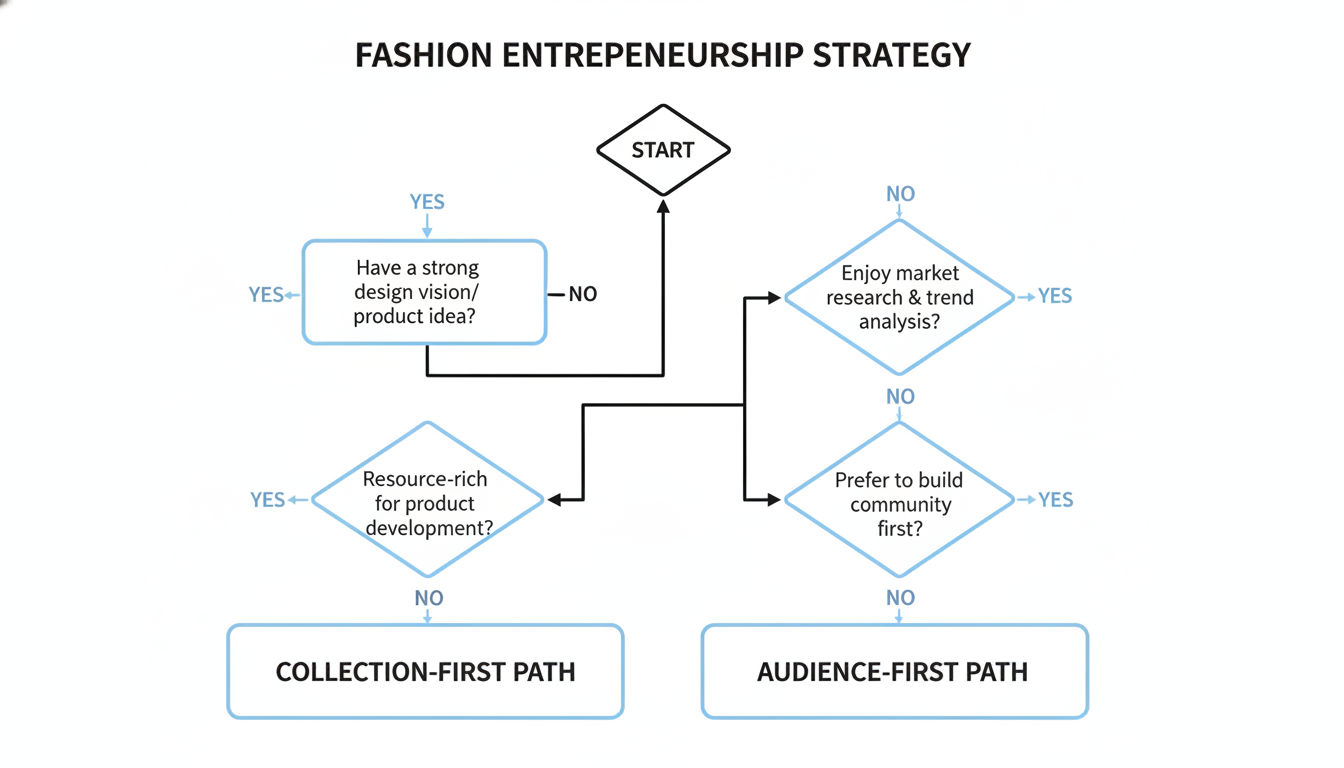
When building an audience first is the smarter move

Next, if your product idea is still vague, building an audience first reduces expensive guesses. This path works best when your niche is broad and you still need to learn what people actually want to buy from you, not just what they like on a mood board.

A common mistake is waiting until every detail is perfect before posting, then getting zero feedback until you have already spent weeks sourcing and sampling. The fix is to treat your early content like a low-cost fitting room: you test concepts, language, and price comfort before you commit to inventory.

If you do one thing, make proof of interest before you make more product. Aim for a simple, repeatable system you can run for 2 to 4 weeks:

  • Pick 3 content pillars (for example: outfit formulas for work, fabric education, behind-the-scenes fit notes)

  • Post on a consistent cadence you can keep (for example: 3 posts a week plus 1 short video)

  • Start an email list and offer one clear reason to join (early access, sizing help, launch discount)

  • Create one simple offer to measure intent: a pre-order, a waitlist, or a limited deposit

Here’s the catch: “Audience-first” can fail when you post for months with no clear next step to buy. If you’re short on time, skip complex branding work and focus on one landing page, one email welcome message, and one way to raise a hand (waitlist or pre-order).

Closing remarks

Next, remember this when you feel stuck: clarity comes from action, not overthinking. If you wait until every detail is perfect, you usually trade speed for a feeling of control, and you lose the feedback that would actually guide your next move.

So pick one uncertainty to remove first this month: who you’re for or what you’re selling. Then run one simple test in the next 7 to 14 days:

  • If you’re unsure who you’re for, post 3 short pieces of content aimed at one specific buyer type and track replies, saves, or DMs

  • If you’re unsure what you’re selling, offer one clear item or pre-order to a small list and track clicks, questions, and purchases

If you do one thing, do this: write down your test, your success signal, and the date you’ll review it. In practice, even a small result beats a month of guessing.