-------------------------------------
Milan Fashion Campus
Jun 28

How to Build a Capsule Wardrobe for Clients (Stylist Guide)

Key Takeaways

  • A client-first capsule wardrobe starts with lifestyle and identity, not a generic checklist of essentials

  • The stylist’s edge is building a repeatable system: audit, edit, outfit formulas, then a targeted shopping list

  • A wardrobe styling course can accelerate closet analysis, color and proportion skills, and practical client communication

From closet chaos to a clear system clients can actually wear

Your client has 60+ items, yet they rotate the same 6 outfits every week and still say, “Nothing works.” The issue usually is not a lack of clothing, it’s a lack of matching pieces, clear outfit plans, and confidence about what goes together.

So the first benchmark to set is simple: aim for 20–40 core pieces that can produce 30+ outfits in real life. By the end of this section, you’ll have a step-by-step capsule process you can run with a client in a single session, then refine over 1–2 weeks as you confirm gaps and fit.

Next, run the capsule process in this order so you fix the system before you buy anything new:

  1. Define the client’s “real week” (workdays, off-duty, events) and choose 2–3 priority situations to style first

  2. Pull a draft core: 20–40 items that already fit, match the client’s life, and can be worn this month (not “someday”)

  3. Make quick outfit formulas (like “top + layer + bottom + shoe”) and build 10 outfits in 30 minutes to test what’s missing

  4. Tag friction points: comfort, weather, dress code, laundry cycle, shoes that hurt, fabrics that itch

  5. Write the smallest possible shopping list: 3–8 items that connect multiple outfits, not one-off “statement” fixes

Here's the catch: a capsule works best when the client repeats outfits on purpose and rotates accessories, shoes, and layers. It fails when the “core pieces” are fantasy items that don’t match their daily comfort needs, or when you choose colors that look good on a rack but don’t mix at home.

If you do one thing, do this: build outfits before you shop. A common mistake is editing the closet down to a tight set and then realizing none of it forms complete looks for Monday through Friday; the fix is to create at least 10 wearable outfits first, then edit with proof in front of you.

Start with the client, not the clothes
So before you pull a single hanger, get clear on who the capsule wardrobe is for and what their real week looks like. A capsule that works for a mostly remote job will fail for someone who needs 4 office days and 2 client dinners, even if both “like neutrals.” Your first win is to replace guesses with a short intake that produces usable constraints.

Use intake questions that connect style to daily behavior, not fantasy scenarios:

  • Routine: How many days are work, errands, social, travel in a typical week

  • Dress codes: Office rules, uniforms, religious or cultural needs, event frequency

  • Confidence colors: Colors they get compliments in, and colors they avoid

  • Avoided items: “Never again” pieces (itchy knits, high heels, low rise, clingy fabrics)

  • Body proportions: What they like to feature and what they prefer to downplay

  • Budget and shopping pace: One big shop vs 1 to 2 items per month

  • Desired message: Three words they want to signal (for example: calm, sharp, creative)

Here’s the catch: most clients describe style in vague labels, so translate them into outfits. If they say “polished,” ask what that means in practice, such as a blazer vs a knit jacket, pointed flats vs sneakers, or gold jewelry vs no jewelry. If you do one thing, do this translation step, because it stops you from building a closet full of technically “right” pieces that still feel wrong on.

Next define the capsule goal in one sentence, then use it as a filter for every keep, tailor, and buy decision. Common goals are ease of dressing (10 minutes from shower to door), fewer random buys (no duplicates unless they solve a real outfit gap), and a consistent personal style across real life (work, weekends, and events using the same core items). If you’re short on time, skip trend talk and write the goal plus 2 non-negotiables, like “must work with sneakers” and “no dry-clean-only.”

Audit, edit, and restyle before you shop

Next, make the closet do the first round of work so you do not shop to fix problems that are actually fit, styling, or repetition.

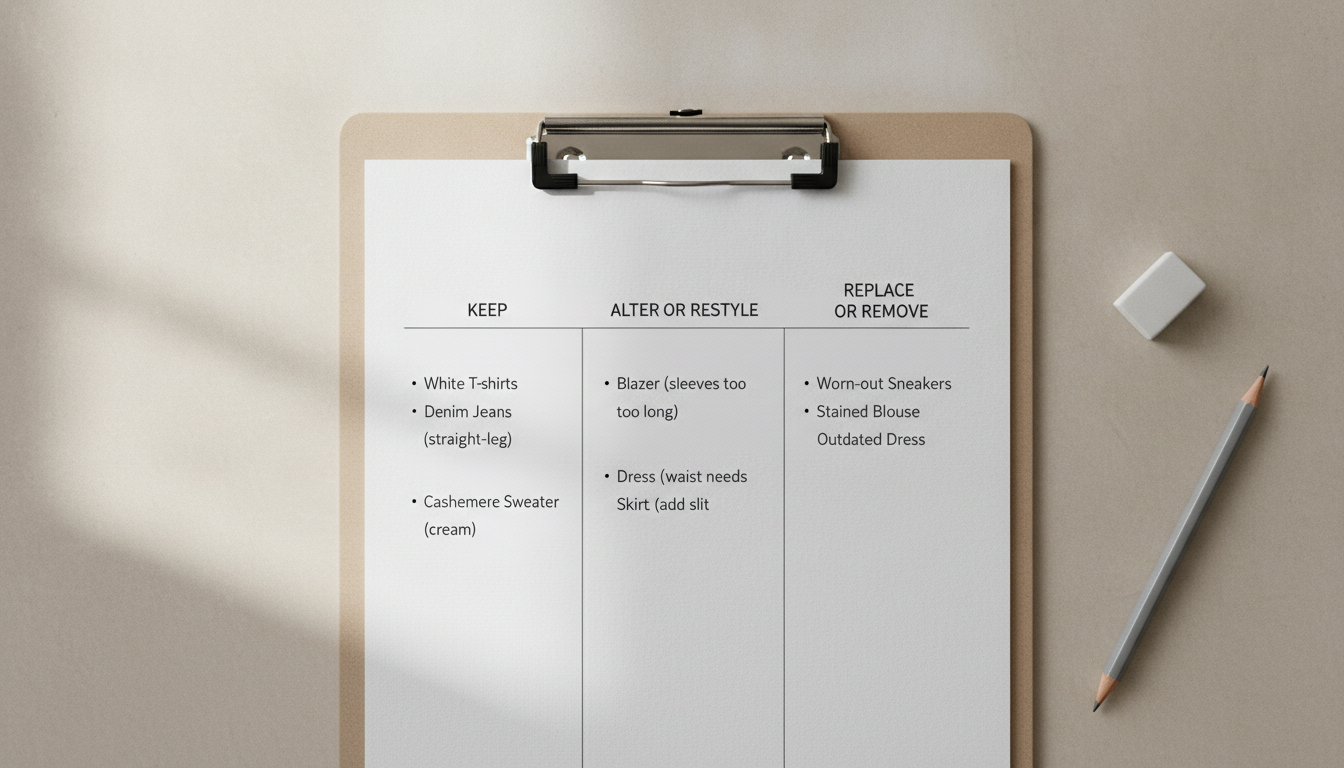
Run a quick audit with three buckets:

  • Keep: fits well, matches the client’s weekly life, and gets worn at least a few times per month

  • Alter or restyle: good quality but needs a hem, waist tweak, button swap, or a new pairing to feel current

  • Replace or remove: uncomfortable, worn out, hard to style, or never chosen even when it is clean and available

If you do one thing, start by pulling 20 items and sorting them in under 30 minutes. The goal is momentum, not perfection.

Also, flag the capsule killers early, because they quietly create clutter and “nothing to wear” days:

  • Poor fit: sizing up for comfort, shoulders that drop, gaping waistbands, or tight armholes that make layering impossible

  • Lifestyle mismatch: a closet full of office pieces for a client who now works from home 4 days a week

  • Trend-copying: buying what looks good online but does not match the client’s colors, proportions, or comfort level

  • Duplicates of basics: five black tees, three similar denim cuts, or two nearly identical blazers that compete instead of support outfits

Here’s the catch: editing too aggressively can backfire when the client has limited laundry time. If they need a 7-day outfit rotation, keep enough tops to cover the week and remove only the duplicates that lose on fit or fabric.

Build the capsule system with outfit formulas and a smart shopping list

Next, turn “a pile of good items” into a repeatable system by writing outfit formulas first, then filling them with pieces.

A simple way is to build formulas by category (tops, bottoms, layers, shoes, bags, accessories) and then match them to the client’s real week. For example, if they have 3 office days, 1 client dinner, 2 casual days, and 1 travel day, you want formulas that cover all of those without needing a different outfit for every single occasion.

Here’s a practical set of outfit formulas you can reuse across clients, then customize:

  • Work: structured bottom + simple top + layer + closed-toe shoe + medium bag + 1 accessory

  • Smart casual: dark denim or tailored pant + knit or button-up + optional layer + loafer or clean sneaker + crossbody

  • Weekend: relaxed bottom + tee or casual shirt + light layer + sneaker + hands-free bag

  • Event: dress or matching set + dressy shoe + small bag + 2 accessories

  • Travel: comfortable bottom + breathable top + warm layer + walkable shoe + tote or backpack

Common mistake: starting with a shopping list before you know the formulas. Fix it by writing 4–6 formulas, then checking which items the client already owns that can “fill” each slot.

So when you do shop, pick pieces that can plug into multiple formulas, not one-off looks. If you do one thing, make sure every new item works with at least 3 existing items across two different outfit formulas.

Use this quick versatility checklist:

  • Coherent color story: 2–3 main neutrals plus 1–2 accent colors the client already wears

  • Functional silhouettes: shapes that match the client’s lifestyle (for example, wide-leg pants fail if they bike daily without a workaround)

  • Layering options: at least 2 layers that work over 3 tops (for example, blazer + cardigan that both work with tee, knit, button-up)

  • Seasonality planning: a clear plan for hot vs cold weeks (for example, swap wool with cotton, add tights, or add a warmer layer)

If you’re short on time, skip hunting for “statement” pieces and focus on filling the missing slots in the formulas first (often: a layer, a walkable shoe, and one bag that fits the client’s daily carry).

In practice, the shopping list should be written in “slots,” not brands, so you can shop in any budget and in any city. Keep it tight and measurable.

Example smart shopping list (8 slots):

  • 1 work layer (blazer or structured jacket) in a primary neutral

  • 1 casual layer (cardigan, chore jacket, or denim jacket)

  • 2 tops that can dress up and down (one knit, one woven)

  • 1 bottom that works for work and weekend (tailored pant or dark straight jean)

  • 1 walkable shoe that still looks polished (loafer, ankle boot, or clean sneaker)

  • 1 day bag that fits the client’s essentials (phone, keys, wallet, water bottle)

  • 1 accessory “finisher” (belt or simple jewelry set)

Tradeoff to explain to clients: the more consistent the color story, the easier the outfits, but the less variety they feel day to day. If they get bored easily, add variety through accessories and textures (leather, denim, knit) instead of adding new colors.

Closing remarks

A wardrobe is not just storage. It is a daily language.

So if you want your client to feel consistent, seen, and ready on a Monday morning, aim for a wardrobe system, not a pile of good outfits. A few repeatable outfit formulas and a small set of anchors often do more than another “perfect” piece that only works once.

Next, ask yourself this: what would change for your next client if you built a wardrobe system instead of more outfits?

Explore Milan Fashion Campus wardrobe styling courses

FAQ

What is a capsule wardrobe?

A capsule wardrobe is a small, planned set of clothes that mix easily. It focuses on pieces that fit your lifestyle, work together in color and shape, and create many outfits with fewer items.

How many pieces should a capsule wardrobe have?

There is no fixed number. Many people start with 25 to 40 pieces for a season, including shoes. If you are short on time, start with 12 to 15 core pieces that cover work and weekend first.

Can a capsule wardrobe include colors and prints?

Yes. Keep a simple base palette, then add 1 to 2 accent colors and a few prints that repeat that palette. The catch is scale and clash, so limit prints to 2 to 4 pieces that pair with most tops or bottoms.

Is capsule wardrobe styling useful for personal stylists?

Yes, especially for clients who feel stuck, shop impulsively, or need reliable outfits fast. It works best when the client wants repeatable looks; it fails when they want constant novelty, unless you plan a rotating capsule schedule.

Can I learn capsule wardrobe styling online?

Yes. Look for lessons that cover client intake, closet editing, outfit formulas, and shopping lists, plus before-and-after case work. If you do one thing, practice building 10 outfits from one mini-capsule, then adjust based on feedback.