-------------------------------------

Fashion Design After the AI Shift

May 20 / Milan Fashion Campus

Key Takeaways

AI can speed up early-stage concepting, especially when you need 20 silhouette ideas in 15 minutes or you are mapping color and print directions for a capsule. But the strongest fashion results still depend on your taste, your editing, and your garment knowledge, like knowing what a seam can actually do on the body.

The most valuable AI skills are practical, not technical. Think: writing prompts that specify details (fabric weight, closure type, proportion), judging images like a designer (fit, balance, construction clues), and translating a visual into something wearable like a flat sketch, tech pack notes, or a first toile.

A good AI fashion course should teach real workflows from brief to outcomes, not tool hype. Look for guided feedback, time-boxed exercises such as one hour for concepting and one hour for edits, and deliverables you can add to a portfolio such as a mini collection with lineup, flats, and material notes

When your sketchbook meets prompts and generators

Picture this: you sketch a mini collection on Sunday, and by Monday morning an image generator has produced 40 variations of the same idea in different fabrics, silhouettes, and color stories. The speed feels like a win until you hit the real problem, deciding which 3 concepts deserve pattern work, fittings, and time on a mannequin.

A practical benchmark is that AI can produce dozens of concept variations in minutes, which moves the bottleneck from production to judgment and direction. The designers who move fastest are not the ones who type the longest prompts, but the ones who can spot what fits the brief, what looks new, and what will actually work in real materials.

What changes is the early phase of ideation: you can test shape, proportion, print placement, and styling without redrawing everything. What does not change is your responsibility to make decisions like a designer, including why a look belongs in the collection, how it supports the target customer, and whether it can be constructed at the chosen price point.

By the end of this post, you will know what shifts when AI joins your process, which skills are worth building next, and how to choose training that helps in real studio work. If you do one thing, focus on improving your ability to give clear direction and edit ruthlessly, since quantity is no longer the hard part

Why AI matters in fashion right now

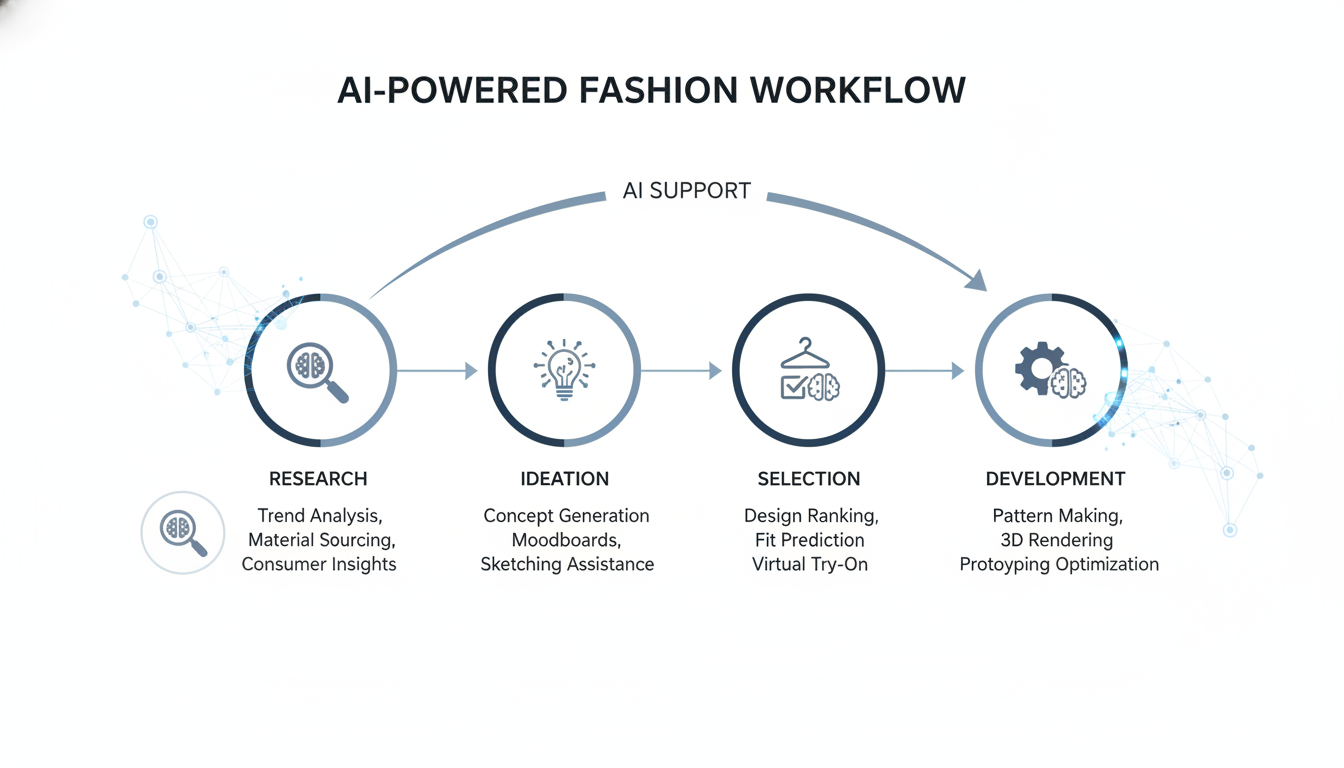
Also, AI already sits inside parts of fashion work that used to take days of manual searching and sketching. If you have ever built a mood board from scratch at 11 pm, you have felt the time cost: a single concept can mean 2 to 4 hours of image research, sorting, and reworking.

Where it shows up most often is in quick iteration and pattern spotting, not in replacing taste. Common uses you can expect to see in studios and small brands include:

  • Visual research that pulls broad references in minutes, then you curate the few that fit your story

  • Mood boards that start from a prompt, then you refine layout, palette, and references by hand

  • Rapid prototyping for silhouettes, prints, or colorways, so you can compare 10 options before choosing 2

  • Personalization in e-commerce such as styling suggestions based on browsing behavior

  • Predictive insights that help teams guess demand for a category, color, or price band

What is really changing in the design process

So the biggest shift is speed early on, and rigor later. AI can get you from mood references to 10 to 30 first-pass visuals in an hour, which used to take a day or more of sketching and collage. The bottleneck moves to selecting what is worth developing, then refining it into something that can be made, worn, and sold.

If you do one thing, make your process more selective instead of more prolific. Treat AI outputs like rough thumbnails and set a short review window, for example 20 minutes to pick 3 directions, then discard the rest. A common mistake is to keep generating until everything looks good, which creates a pile of pretty images with no clear product plan.

Next, keeping concepts wearable means translating visuals into product decisions. For each chosen look, connect it to a real category such as a midi dress, cropped jacket, or wide-leg trouser, then pin down the basics before you get fancy.

Use this quick feasibility checklist:

  • Silhouette: what is the outline and where does volume sit

  • Fit: where is it close vs loose and what body area needs ease

  • Fabric: 1 to 2 likely materials and why they suit drape or structure

  • Construction: 2 to 3 key details such as darts, pleats, zipper, knit rib, seam type

  • Components: closures, lining, pockets, trims

  • Constraints: cost target, size range, season, and how it will be produced

Skills designers need today to stay original

Also, staying original now depends less on finding the one perfect tool and more on sharpening the skills that guide any tool. A useful benchmark is whether you can produce 10 clear variations in 30 minutes without them looking like the same “nice image” with a different colorway.

Core skills that show up in real workflows include:

  • Prompt writing: describing silhouette, fabric behavior, construction details, and mood in plain words

  • Trend interpretation: translating what you see on runways or TikTok into a point of view, not a copy

  • Visual storytelling: building a mini narrative across a 6 to 12 look capsule so the collection reads as one idea

  • Image editing: fixing hands, seams, print scale, and lighting so outputs look intentional

  • Portfolio thinking: curating outcomes as a series with process shots, not a folder of random renders

Here’s the catch: AI outputs get generic fastest when you start with aesthetics instead of a concept. If you do one thing, do this first: write a one sentence concept and define 3 constraints before you generate anything.

A simple originality safeguard you can use on any project:

  • Define the concept first: who is the wearer, where are they going, and what must the garment do

  • Build constraints: pick a limited palette, one hero material, and one construction rule (for example, no set in sleeves)

  • Check for “pretty but generic”: if you can’t explain what makes the idea yours in 15 seconds, revise the concept and regenerate

Works best when you already have references and a clear customer in mind, but fails when you feed the model a vague mood like “minimal luxury” and hope the computer supplies the design point of view.

Closing remarks

So here’s the line to hold onto: “Style is a voice.” AI can make that voice louder and faster to test, but it cannot decide what you stand for, what you refuse, or what you repeat on purpose.

If you do one thing next, make fewer images and better choices. Ask yourself what you would change in your process this month to create fewer options and stronger decisions, like limiting yourself to 10 prompt variations per concept, doing a 20-minute edit pass before generating anything new, or saving only 3 finalists to show a teammate.

Explore AI fashion design training at Milan Fashion Campus

Next, if you want guided practice (not just experimenting alone), Milan Fashion Campus offers two clear paths: an in-person course in Milan and an online course you can complete from anywhere.

This works best when you need feedback on your process, like turning a rough concept into a set of usable outputs for a collection. It can fall short if you only want a quick overview, since the value comes from doing the exercises and applying them to your own design work.

If you do one thing, choose the format that matches your current constraint:

  • If you need face-to-face training and a set schedule, look at the AI Fashion Design Course in Milan (courses start every Monday, with classes held Monday to Thursday)

  • If you need flexibility around work or school, choose the Online AI Fashion Design Course (typical fastest completion is about 4 weeks, with up to 1 year access time)

Common mistake: picking based on location only. Fix it by deciding based on how you learn best, either live guidance and a tight routine, or self-paced time blocks you can keep each week.

Both options focus on using generative AI tools inside real design tasks, not just making images. Expect practice with:

  • Prompting skills, including using parameters and image prompts to control results

  • Mood boards and concept direction, including mixing styles and prints

  • Iterations like variations, upscaling, and color exploration to move from idea to clearer visuals

  • Applications across roles, for example a designer building a mini capsule, a stylist planning looks, or a photographer testing product shoot concepts

AI Fashion Design Course in Milan: https://www.milanfashioncampus.eu/ai-fashion-design-course

Online AI Fashion Design Course: https://academy.milanfashioncampus.eu/course/ai-integration-fashion

FAQ and next steps

Is AI replacing fashion designers?

AI is changing tasks, not removing the need for designers. It works best for generating options fast, like colorways or print variants. It fails when brand taste, fit decisions, and real-world constraints matter, so human judgment stays central

Is drawing still useful after AI tools?

Yes. Drawing trains proportion, silhouette, and visual clarity, which helps you spot weak AI outputs fast. If you only do one thing, keep a weekly sketch habit, even 20 minutes, so your eye stays sharp while tools change

Can beginners learn AI for fashion without losing fundamentals?

Yes, if you set limits. Learn one AI tool for ideation, then do the fundamentals by hand: a clean flats sheet, measurements, and fabric notes. A common mistake is skipping construction details, so add a tech pack step after prompts

Is AI only useful for digital fashion?

No. AI can support physical product work too, like faster mood boards, print placements, and sample feedback summaries. It works best early in concepting. It is less reliable for exact fit and fabric behavior, so you still need sampling

What is the biggest lesson from how AI is changing fashion design?

Speed is no longer the main advantage. Originality comes from your inputs: references, constraints, and point of view. If you are short on time, skip chasing new tools and write clearer prompts tied to a real customer and product brief

Next step for broader industry context