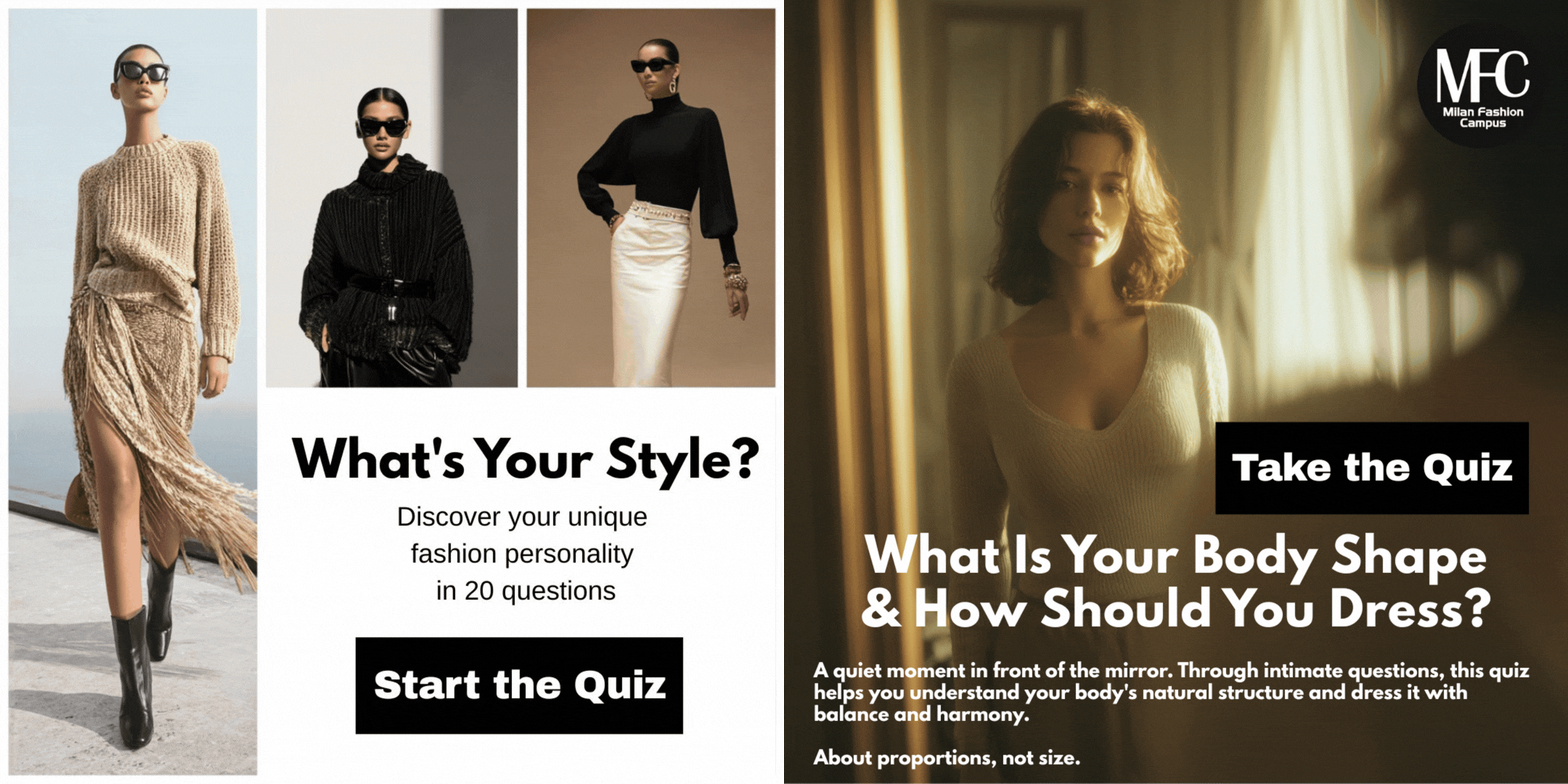
But what people are really looking for goes beyond a simple result. When someone types what’s my style quiz or what is my fashion style quiz, they are often asking a deeper question: how do I define myself visually?
A find your style quiz works as a mirror. It reflects your instincts—your attraction to certain silhouettes, colors, or moods. Whether it leads you toward minimalism, streetwear, romantic aesthetics, or something more eclectic, it helps you recognize patterns you may not have consciously noticed.
However, style is not a fixed category. A what is my clothing style quiz can guide you, but it cannot define the full complexity of your identity. Real style evolves with experience, environment, and self-awareness.
Understanding this difference is essential. A find your style quiz is not the destination—it’s the beginning of a process that involves observation, experimentation, and refinement.
How to find your personal style quiz free
Free online tools are a great entry point for anyone starting their style journey. Searching for a find your style quiz often leads to platforms that ask about your preferences, lifestyle, and visual inspirations.
These quizzes are useful because they simplify the process. They help you move from confusion to a first level of awareness. But their real value lies in how you interpret the results. Instead of taking them literally, use them as a base to explore further—look at references, analyze outfits, and test combinations in your own wardrobe.
What is my fashion style quiz online
A what is my fashion style quiz is essentially a structured way to decode your aesthetic tendencies. It combines psychology, visual culture, and trend analysis into a simplified format.
Online quizzes categorize styles into recognizable groups—classic, edgy, casual, elegant—but in reality, most people exist between these categories. The goal is not to fit into a label, but to understand which elements resonate with you and why.
This awareness allows you to build a wardrobe that feels coherent, not random.
Best find your style quiz 2026
The “best” find your style quiz is not necessarily the most complex one, but the one that helps you reflect. In 2026, with the rise of AI and personalized content, quizzes are becoming more adaptive and intuitive.
Yet, even the most advanced tools cannot replace personal judgment. The best results come when you combine digital insights with real-world observation—studying how garments fit, how colors interact with your skin tone, and how outfits communicate mood and intention.
How to discover my clothing style
Discovering your style goes beyond answering questions—it requires developing visual sensitivity. Why does a look feel balanced? Why does one outfit appear effortless while another feels forced?
These are the questions that transform a simple what is my style quiz into a deeper understanding of fashion as a language. Style is built through consistency, awareness, and the ability to edit.
Some people begin with a find your style quiz, but then move toward more structured learning to refine their eye and translate inspiration into real outfits.
What’s my style quiz accurate results
Accuracy in a what’s my style quiz depends less on the algorithm and more on your honesty. The more intuitively you answer, the more meaningful the result becomes.
Still, no quiz can fully capture your identity. Style is fluid, and it changes as you grow. The most accurate result is not a label—it’s the clarity you gain about what feels authentic to you.
Understanding style at this level requires more than quick answers. It involves learning how to read fashion, interpret visual signals, and construct a personal narrative through clothing. Some educational paths focus exactly on this approach, helping individuals move from inspiration to intention.
Milan Fashion Campus, based in the heart of Milan, represents one of these environments. Founded by Angelo Russica—who has collaborated with major fashion houses—the school offers short, intensive courses designed to connect creativity with real industry practice. Students are guided to understand not only how to identify a style, but how to build one with coherence and purpose .
Because in the end, style is not something you find once.
It’s something you learn to express.