-------------------------------------

How to Price Personal Styling Services for a Personal Stylist Business

Price your personal stylist business with clear styling service prices, packages, hourly rates, and value. Learn a simple model and start today.
Jun 28 / Milan Fashion Campus

Key Takeaways

Clear, consistent pricing comes from knowing your real numbers and spelling out what the client gets. When your rate is tied to time spent, direct costs (like travel or wardrobe pulls), and measurable deliverables (like a 2-hour closet edit plus a shopping list), it is easier to explain and defend.

  • Build prices from real time + real costs + clear deliverables

  • Clients buy outcomes they can picture (before/after, photos, a plan), not your effort

  • If you do one thing, write deliverables in plain language before you set the price

Packages often sell better than hourly because clients can compare options fast and know what success looks like. For example, a “90-minute virtual closet refresh with 10 outfit formulas” is easier to say yes to than “$X per hour,” even if the total is similar.

  • Packages work best when the scope is repeatable across clients

  • Hourly can fail when clients ask for open-ended support or add-on requests

  • Protect your income and the client experience with boundaries like deposits, revision limits, and a clear scope

When you love styling but freeze at the pricing question

You finish a great style session, the client asks, “What do I owe you for this?” and your brain jumps straight to the fun part you just did, not everything around it. Then you quote a number, and later realize you forgot intake, planning, research, travel, admin, and follow-up.

A common pattern for new freelancers is underpricing by about 20–50% once those hidden hours and expenses are counted. The good news is you do not need to guess your way out of this. You need a repeatable way to count your real time and costs, then decide what you must earn per hour to stay booked without burning out.

Here’s what often gets missed the first time you price a styling service:

  • Client intake: 15–30 minutes (forms, messages, scheduling)

  • Closet review prep: 30–60 minutes (notes, outfit goals, weather, dress code)

  • Shopping research: 1–2 hours (store inventory checks, cart building, holds)

  • Travel and parking: 30–90 minutes depending on your city

  • In-session time: the part you usually remember

  • Returns and exchanges: 30–120 minutes if you shop in person

  • Post-session wrap-up: 30–60 minutes (lookbook links, refund tracking, care notes)

Here’s the catch: pricing works best when you charge for the whole service, not just the “face time.” If your client only sees 2 hours together but the job takes 5 hours total, your rate is quietly getting cut by more than half.

If you do one thing today, do this quick check before you quote:

  1. Write down the total hours you expect from first message to final follow-up

  2. Add any direct expenses (parking, software subscriptions, shipping supplies, assistant help)

  3. Divide your price by your total hours to see your real hourly pay

If you’re short on time, skip building a full menu and start with one signature service you can measure, like a 2-hour closet reset or a half-day shopping session. Track your time for 3 clients, then adjust your pricing based on what the work actually took.

Common mistake: copying another stylist’s rate from social media. Fix: price from your own reality, including commute time, local store options, and how much follow-up your typical client needs.

Build your baseline price from time, costs, and capacity
Next, you need a price floor that keeps you paid even when a client asks for “just a quick session.” The goal is not a perfect number, it’s a baseline you can trust, built from your real workload and what it takes to run your business week to week.

Start by listing every step you actually do for one client, not the steps you wish you did. A typical personal styling workflow often includes consult, questionnaire, wardrobe review, research, the live session, deliverables, follow-up, and travel time.

Use this checklist and add your own steps, then estimate time for each in minutes or hours:

  • Consult call (for example 30 to 60 minutes)

  • Client questionnaire review (15 to 30 minutes)

  • Wardrobe review prep and notes (45 to 90 minutes)

  • Research and outfit planning (2 to 4 hours)

  • Shopping or session time (2 to 5 hours)

  • Deliverables: lookbook, links, notes (1 to 3 hours)

  • Follow-up support (15 to 45 minutes)

  • Travel, parking, setup, returns (30 minutes to 3 hours)

Common mistake: pricing only the session time and “throwing in” prep and follow-up. Fix it by treating deliverables and admin as billable work, because they are what makes the service feel complete.

Then convert the total into an hourly floor using your costs and your realistic capacity. If you do one thing, do this: price from weekly capacity, not from a fantasy calendar.

  • Add up weekly business costs (tools, software, insurance, transport, photo apps, styling kit refresh) plus a weekly pay target for yourself

  • Add admin time you cannot bill directly (posting content, invoicing, DMs, supplier calls). If you spend 6 to 10 hours a week here, count it

  • Decide weekly client capacity you can deliver without burning out (for example 2 clients a week if each client takes 6 to 10 total hours)

  • Divide your weekly revenue target by your total working hours (client hours + admin hours) to get your hourly floor

Here’s the catch: this works best when your time estimates are honest, and it fails when you undercount revisions, returns, or travel. If you’re short on time, skip perfect tracking and run this once using conservative estimates, then update it after your next 3 clients.

Choose a pricing model clients can say yes to

Next, pick a pricing model that fits the job so the client understands what they are buying without a long call.

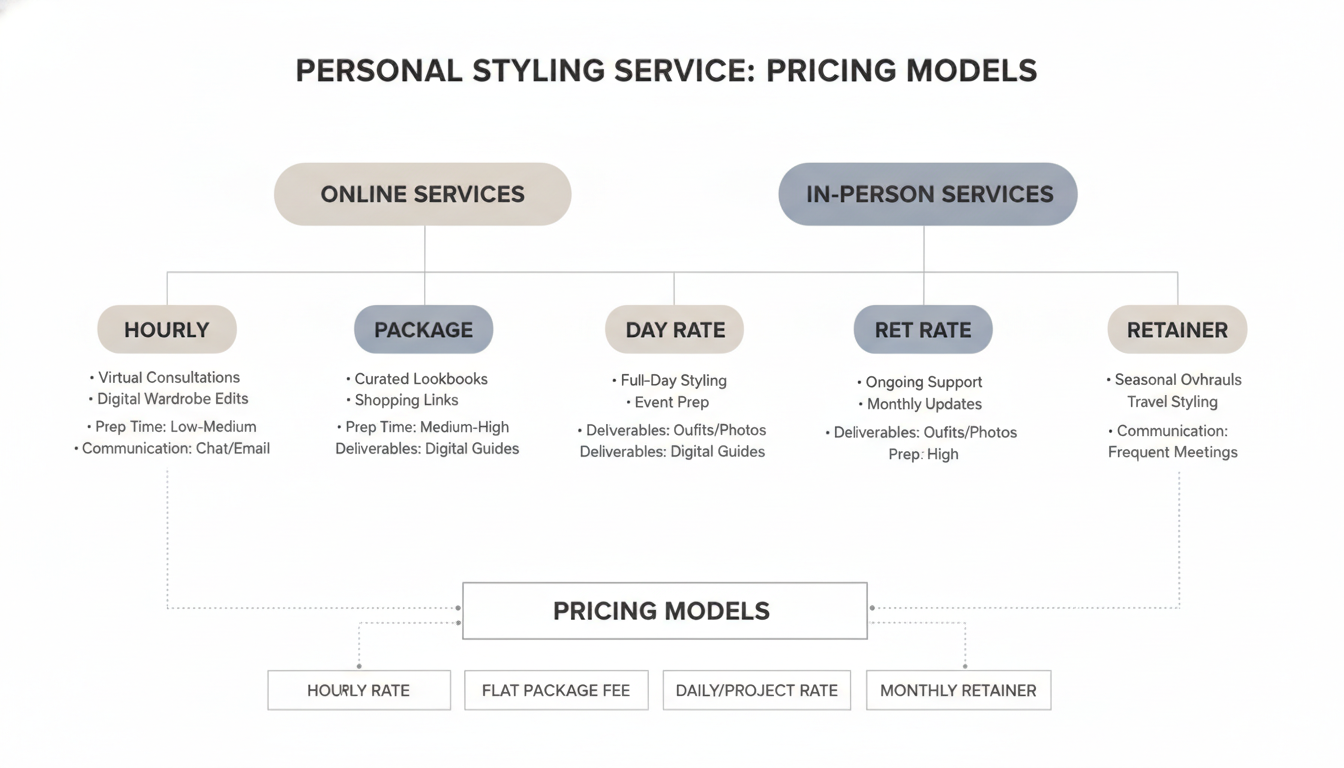
A simple rule: charge hourly for short, defined help; charge a package when you are responsible for a before-and-after result; use a day rate when the work blocks a full day; use a retainer when the client needs you on call across the month.

Start by mapping your most common requests to the model that makes the "yes" decision easiest:

  • Closet edit tune-up (60 to 90 minutes) → hourly

  • Online outfit ideas for one event (2 to 3 rounds of options) → hourly or mini package

  • Seasonal wardrobe reset (2 to 4 weeks, multiple touchpoints) → package

  • Brand shoot styling (8-hour shoot day plus a prep half-day) → day rate

  • Executive who needs weekly outfit planning (4 check-ins per month) → retainer

If you do one thing, do this: make your model match the way the client measures success. If they care about a specific outcome, a package is easier to agree to than an open-ended hourly total.

Also, keep online vs in-person pricing consistent by charging for what actually changes: prep, deliverables, and communication time.

Use a quick framework you can explain in one sentence:

  • Base service price (your styling time)

  • Prep time (research, pulling options, building outfits)

  • Deliverables (lookbook pages, shopping list size, links, notes)

  • Communication (number of check-ins, voice notes, revision rounds)

For example, an in-person shop might be 3 hours on the floor with 30 minutes of pre-planning, while an online shop might be 90 minutes of calls plus 2 to 3 hours of link pulling and a 10 to 20 item shopping list. The hours differ, so the price should differ, even if the client calls both "shopping help."

But watch for a common mistake: underpricing online work because the meeting time looks shorter.

Fix it by tracking the hidden time for two weeks and updating your model:

  • Count DMs and voice notes as communication time

  • Put a cap on revisions (for example, 1 round included, extra round billed hourly)

  • Define deliverables up front (for example, 12 look ideas, 1 PDF, 1 shopping list)

Here’s the catch: hourly works best when the task is bounded; it fails when scope keeps expanding. If your calls keep running long, switch that service into a package with a clear boundary.

Turn services into clear packages with deliverables and boundaries

Next, make it easy for a client to understand what they are buying in 10 seconds. A “style refresh” sounds vague, but “8 outfits + a 12-item shopping list + 14-day follow-up” feels concrete and comparable.

If you do one thing, do this: write your package outcomes as things the client can count or use right away. For example:

  • Number of outfits built (ex: 6 for work, 2 for weekends)

  • Lookbook pages or a PDF recap (ex: 10 pages with photos and outfit notes)

  • Shopping list with links, sizes, and budget ranges (ex: 12 items, each with 2 store options)

  • Wardrobe plan (ex: what to keep, tailor, donate, and replace)

  • Follow-up window (ex: chat support for 7 or 14 days)

But clear deliverables only work if you also define the boundaries, otherwise your “package” turns into an open-ended project. The tradeoff is simple: more flexibility sells well for complex closets, but it fails when you take on clients who want unlimited back-and-forth.

To prevent burnout, set limits in writing and price anything beyond them. A practical boundary checklist you can reuse:

  • Scope limits (ex: 1 closet, not the whole house)

  • Revision count (ex: 1 round of outfit swaps, then add-on)

  • Add-on menu (ex: extra 2 outfits, an additional store, a second shopping edit)

  • Timeline expectations (ex: 48 hours to deliver the shopping list after the session)

  • Deposit and cancellation terms (ex: deposit due to book, rescheduling window)

Common mistake: bundling “shopping” without defining deliverables, then spending 6 extra hours hunting options. Fix it by setting a cap such as “up to 12 items” and letting clients buy additional items as a clear add-on.

Closing remarks

Also, keep this line close when pricing starts to feel personal: “Price is what you charge; value is what your client takes into their life.”

If your work helps someone stop wasting mornings on outfits, feel confident in photos, or finally wear what they already own, the value is bigger than a single closet edit.

What would change in your confidence and client quality if your prices matched your real work and results?

If you do one thing this week, do this quick check:

  • Write one sentence for the result your client gets after 30 days

  • Compare it to your current price and ask if it feels consistent

  • If you are short on time, adjust one package boundary first (hours, number of looks, or support window) before changing everything

Learn practical styling and client-ready business structure

FAQ

How much should I charge as a personal stylist?

Start with your baseline: (hours per client x target hourly pay) + per-client costs. Then compare with your ideal client’s budget and your results. If you’re new, price a smaller package first, then increase after 5 to 10 paid clients.

Should I charge hourly or by package?

Packages usually sell better because clients know what they get. Hourly works for small, defined tasks like closet edits. If you do one thing, package your most common request and keep hourly as an add-on for extra time.

What should styling service prices include?

Include the deliverables and boundaries: consult call length, number of looks, shopping method, fitting time, revisions, and how long support lasts. Also list what is not included, like clothing costs, returns handling, or rush requests unless paid add-ons.

Can I start a personal stylist business online?

Yes. You can offer virtual consults, style boards, shopping links, and outfit plans using client photos and measurements. The catch is fit risk, so set clear rules for photos, sizing info, and returns, and start with clients who already know their sizes.

When should I raise my prices?

Raise prices when your calendar is consistently close to full, you’re turning away inquiries, or you’ve improved your process so you deliver faster. A simple rule: increase after every 10 to 20 paid clients or after adding a new deliverable clients value.