-------------------------------------
Jun 28 / Milan Fashion Campus

How to Start a Personal Styling Business from Home

Start a styling business from home: define online personal stylist services, pricing, portfolio, and get your first clients. Learn the steps now.

Key Takeaways

  • You can start a styling business from home by packaging clear online services with defined deliverables and a repeatable client process

  • Trust comes from specificity: portfolio proof, testimonials, and straightforward pricing that matches outcomes

  • Your fastest path to paying clients is a niche offer, a simple booking flow, and consistent before-after content

From Instagram ideas to paid clients in 30 days

You can post outfits every day and still get zero inquiries if people cannot tell what you sell or what happens after they DM you. The usual pattern is lots of likes, a few “where is that from” comments, and then silence when it comes to paid work because your offer and process are blurry.

A simple benchmark before you pitch your first 10 prospects: 1 niche, 3 service packages, and 1 portfolio page. If you’re short on time, skip daily posting for two weeks and use that time to write your packages and build one clear page that shows your before/after thinking.

By the end of the next 30 days, you should be able to:

  • Define 3 services you can deliver remotely (with clear deliverables)

  • Price each one based on time, prep, and follow-up (not follower count)

  • Build a starter portfolio with 3 to 6 client-style examples (even if they start as “demo” clients)

  • Contact 10 realistic prospects and ask for a paid trial, not “feedback”

Here’s the catch: this works best when you treat Instagram as proof, not as the product. It fails when your bio says “personal stylist” but you never name a specific result, like “workwear refresh for new managers” or “capsule wardrobe for busy parents,” so people do not know if you’re for them.

Common mistake and fix:

  • Mistake: waiting for strangers to request pricing

  • Fix: set packages first, then invite the right people to a simple next step like “DM ‘STYLE’ for the 3 options”

To make it real, think in roles and timelines. For example, a remote stylist can offer a 60-minute closet audit call, 1 week of outfit planning, and a 7-day follow-up; a student stylist can start with a single “event outfit” package delivered in 48 hours; a corporate professional might pay for a 2-week workwear reset if the deliverables are clear.

Choose a niche and outcome so clients know what to buy
Next, make it easy for someone to say yes by being specific about who you help and what changes in a short time window. A simple niche + outcome statement prevents vague inquiries like “Can you style me?” and turns them into a clear purchase.

Write one sentence that includes: the person, the problem, and the measurable result you deliver in 2–4 weeks. For example: “I help women over 40 who feel stuck in dated basics build a 12-piece workwear capsule they can wear in 10 minutes each morning within 3 weeks.”

Here’s the catch: a niche is not a forever decision, but it needs to be one lane for now so your offers and content stay consistent. If you do one thing, pick the lane where you already have credible experience (your own closet, past compliments, past work) and where clients can quickly see an outcome.

Good starter lanes (choose one):

  • Workwear refresh: go from “random outfits” to 10 ready-to-wear looks for Monday to Friday

  • Women 40+: go from “nothing feels current” to 15 outfits that fit your lifestyle and comfort needs

  • Body-shape styling: go from “I avoid half my closet” to 8 outfit formulas that flatter and feel natural

  • Capsule wardrobe: go from “too many clothes” to a 25-item capsule with 20 mix-and-match outfits

  • Men’s image: go from “graphic tees and old jeans” to 2 complete outfits per life area (work, weekend, date)

Common mistake: picking a niche that’s only a vibe (for example, “minimal style”) with no results attached. Fix it by adding a result clients can picture and check, like number of outfits, number of items, or mornings saved each week.

Build online styling services with clear deliverables

Also, clients pay faster when they can picture what they’ll get, not just “styling help.” Turn vague offers into named packages with clear outputs, timelines, and how many looks or items are included so you stop rewriting the scope in every DM.

A common mistake is selling “a full wardrobe refresh” without limits. Fix it by defining what’s included (and what isn’t) before the call, then using the same deliverables every time so your process stays consistent even when you’re busy.

Start with a simple menu you can deliver in 1 to 7 days:

  • Style consultation: 45 to 60 minute video call + recap notes + 3 next steps

  • Wardrobe review: client photo set + your annotated notes + “keep, tailor, replace” list

  • Outfit planning: 10 to 20 outfits mapped to real scenarios (work, weekend, events) + outfit formulas

  • Capsule build: 15 to 30 item capsule list + color palette + 5 mix-and-match rules

  • Shopping list: shoppable links for gaps + 2 price options per item (budget and mid-range)

  • Follow-up support: 7 days of Q&A + one mini revision to boards or list

If you do one thing, make the package deliverable visible: a PDF recap, a board, or a checklist the client can open on their phone.

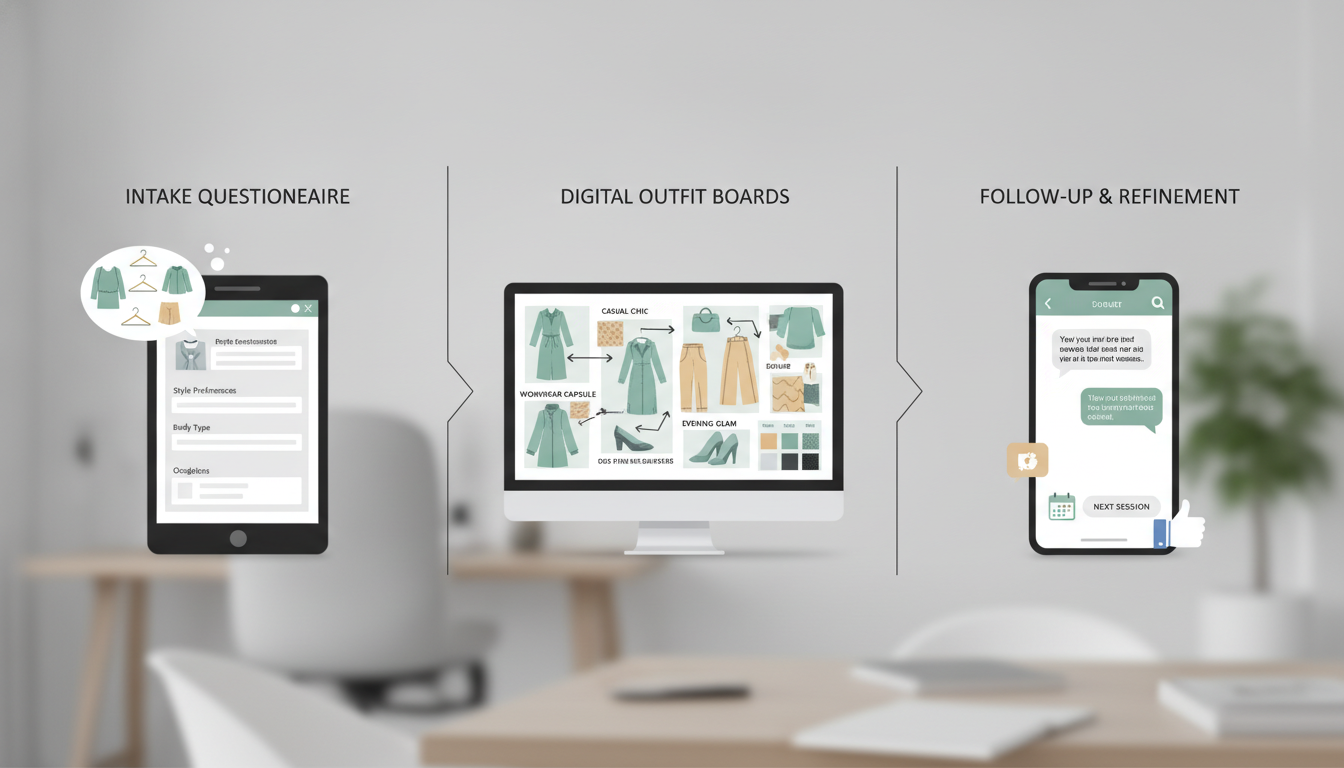
Next, map your method so delivery feels predictable on both sides. This works best when the client can share clear photos and measurements; it fails when they send blurry screenshots and no context, so set requirements up front.

A clean online workflow can look like this:

  1. Intake questionnaire (goals, budget range, sizing, brand preferences, dress code)

  2. Photo review (full-body, key pieces, shoes, problem items)

  3. Video call (prioritize 1 to 2 outcomes, like “office outfits that feel current”)

  4. Digital outfit boards (10 to 20 looks, labeled by occasion)

  5. Shopping links (gap list with sizes, colors, and alternates)

  6. Handover (PDF recap + “what to buy first” order)

  7. Check-in (after 7 to 14 days: what worked, what to swap)

If you’re short on time, skip the live call and replace it with a voice-note summary plus one revision round after the client reviews the boards.

Set beginner pricing that matches time, prep, and follow-up

Next, stop pricing from guesswork and price from inputs. A “1-hour styling call” often becomes 3 to 6 hours once you count analysis time, mood board creation, shopping research, link checking, and client follow-up.

A simple way to start is to list every step you actually do, then assign a time estimate to each. If you do one thing, track your next 3 client requests with a timer so your pricing is based on real time, not hope.

Here’s a beginner-friendly input list you can use to build a price:

  • Call time: 45 to 90 minutes

  • Analysis time: 30 to 60 minutes to review photos, size notes, and goals

  • Board creation: 45 to 120 minutes (mood board or outfit plan)

  • Shopping research: 60 to 180 minutes to find items in budget and size range

  • Revisions: 15 to 45 minutes per round

  • Aftercare: 10 to 20 minutes for a follow-up message or fit check

Here’s the catch: this works best when your deliverables are consistent. It fails when every client gets a fully custom scope, so keep your first offers narrow and repeatable.

Also, publish what’s included so clients can compare offers without a long back-and-forth. Put these details right on your booking page or in a one-page PDF and repeat them in your confirmation email.

Include:

  • Number of looks (for example, 5 outfits for work, or 10 outfits for weekends)

  • Deliverable format (PDF, Google Doc, Canva board, or shop links)

  • Turnaround time (for example, 48 hours after the call)

  • Revision policy (how many rounds, what counts as a revision)

  • Boundaries (what you do not do, like unlimited texting, returns handling, or in-store shopping)

Common mistake: pricing a “package” but giving unlimited revisions and unlimited messages. Fix it by setting a clear revision cap and offering extra revisions or extended aftercare as a paid add-on.

Closing remarks

“Clarity is more important than perfection.”

So as you wrap up your plan, aim for a simple offer someone can understand in 10 seconds, not a long list of options that feels risky to buy. A clear promise and one proof point, like 2 before-and-after outfits, a short client message, or a screenshot of your style board, often does more than polishing your brand colors for another week.

Next, ask yourself this: what is one client problem you can solve this week with one simple package, a clear promise, and proof you can show. For example:

  • A “Closet refresh in 60 minutes” package for busy parents who want 10 outfits from what they already own

  • A “Workwear reset” package for a new job with a 1-week plan and a 20-item shopping list

  • A “Weekend capsule” package for someone traveling with a 12-piece packing list and 6 outfit photos

Learn practical styling skills for remote clients

FAQ

Can I start a styling business from home?

Yes. You can run consultations, closet edits, and shopping support by video call and shared albums. Start with a simple setup: good lighting, a phone tripod, a calendar tool, and a way to take payment. Keep sessions 45 to 60 minutes to stay consistent.

How do I become an online personal stylist?

Pick one client type and one result, then package a small service. For example: a 60-minute consult plus a 20-item lookbook delivered in 48 hours. Practice on 3 to 5 test clients, collect before and after photos (with permission), then start booking paid sessions.

Do I need a fashion degree to start a styling business?

No. Clients pay for clear outcomes like outfits they can wear this week, not a credential. What matters is your process: intake questions, fit and color choices, links within budget, and follow-up. If you are new, start with casual wardrobe basics before offering complex styling.

What services can I offer online?

Offer services that have clear deliverables:

  • Virtual closet edit with a keep, tailor, donate list

  • Personal shopping list with links and budget caps

  • Outfit formulas for work, weekends, events

  • Capsule wardrobe plan for a season

  • Fit checks and returns support over chat

How do I get my first styling clients?

Start with people who already trust you. Ask 10 contacts if they want a discounted first package in exchange for a short testimonial. Post 3 helpful examples per week, like one outfit formula and one budget swap. If you do one thing, track referrals and follow up within 24 hours.