-------------------------------------

Wardrobe Edit: How Stylists Organize Closets

Jun 28 / Milan Fashion Campus

Key Takeaways

A wardrobe edit turns a full closet into a functional system by deciding what to keep, tailor, restyle, replace, or remove.

A closet detox is the decluttering layer, while the wardrobe edit adds styling direction: outfit planning, repeatable combinations, and clearer shopping goals.

For stylists, wardrobe edits require method and empathy, not trend-chasing or aggressive purging.

When you have a full closet but nothing to wear

Picture a client standing in front of overflowing rails at 7:30 a.m., still repeating the same five outfits for work, weekends, and dinners. The problem usually is not a lack of clothes, it is a lack of clear options that work together and fit their real life.

A useful benchmark: many people regularly wear about 20% of what they own. If you do one thing first, make the goal “clear outfit choices” instead of “less stuff.” That shift helps you edit with a plan, not with guilt.

Here’s the catch: more pieces can create more decision stress when nothing is easy to pair, comfortable for a full day, or right for the client’s schedule. A blazer that looks great but feels tight at the desk will stay on the hanger, just like party shoes that hurt after 20 minutes.

In practice, a stylist-led wardrobe edit sorts items into simple categories you can act on the same day:

  • Keep and wear now: fits, suits current lifestyle, can make at least 3 outfits

  • Keep but needs tailoring: fits almost, worth the fix, set a deadline (often 7 to 14 days)

  • Keep but needs styling: good piece, but the client lacks pairings (note 2 outfit formulas)

  • Pause and test: unsure items, do a 2-week wear trial

  • Repair or replace: damaged basics, write a short shopping list with exact gaps

  • Let go: wrong fit, wrong color story, duplicates, or never chosen

Common mistake: clients try to “declutter” by focusing only on what to donate, and they end up keeping a closet full of random survivors. Fix it by building a small set of repeatable outfit formulas first (for example: straight-leg jeans + knit + structured jacket), then keep only what supports those formulas.

What a wardrobe edit is and what a closet detox is
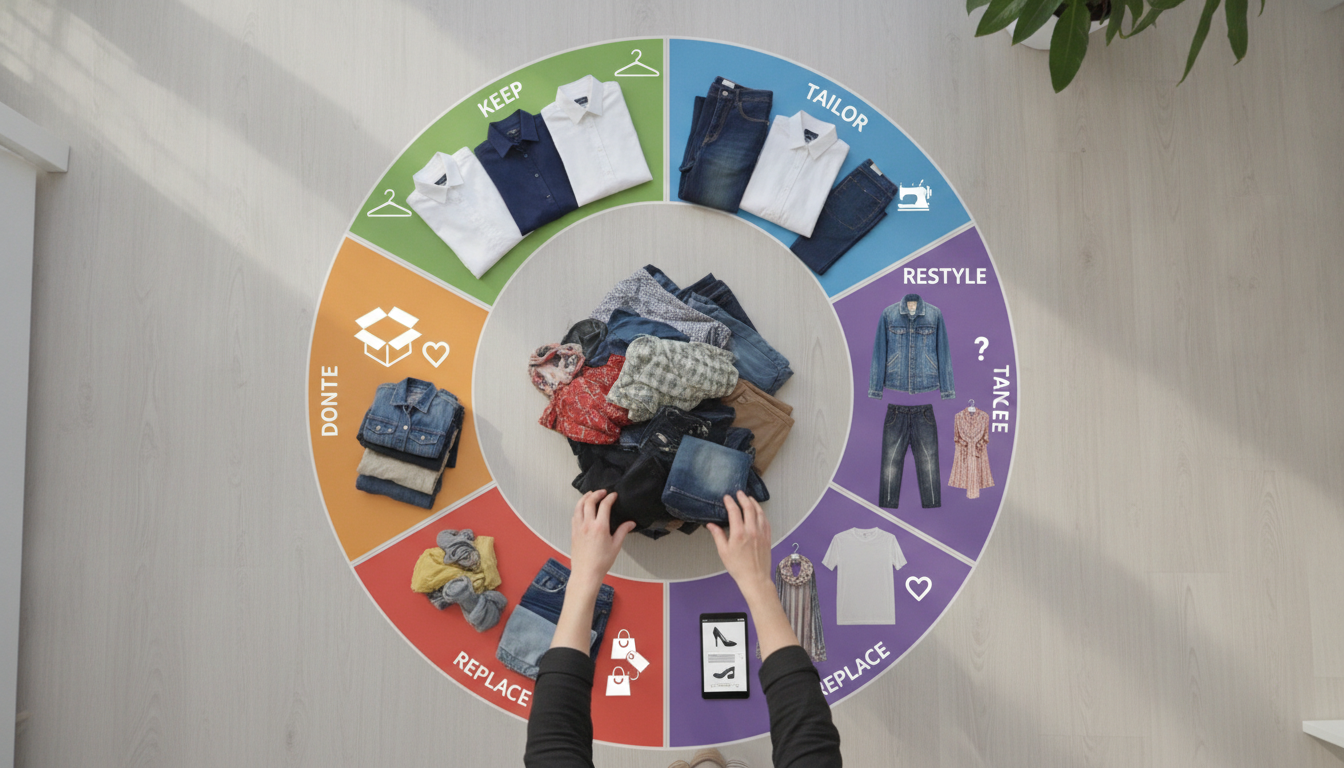
Next, it helps to separate two ideas that often get mixed together. A wardrobe edit is a guided review of what you own so your clothes match your real life, fit well, and mix into outfits you will actually wear. A closet detox is a faster clear-out focused on removal, where the main goal is to reduce volume and decision fatigue.

Success looks different depending on which you are doing. For a wardrobe edit, success is having a smaller set of clothes that makes at least 10 ready-to-wear outfits for your workweek or typical schedule, with fewer "maybe" items. For a closet detox, success is opening your closet and seeing space, clear categories, and only items you can wear in the next 30 to 90 days.

Here’s the catch: a detox without an edit can leave you with gaps that make shopping feel urgent later. If you do one thing, do the edit first, because it tells you what to keep and what you still need.

A stylist typically evaluates:

  • Lifestyle needs: commute, dress code, climate, how often you go out, how often you do laundry

  • Fit and body shape: where items pull, gap, ride up, or require constant adjusting

  • Color direction: which shades make your skin look clear and which make you look tired, plus how well your colors mix together

  • Goals: "more polished," "more casual," "less time getting dressed," "pregnancy or postpartum," "new role at work"

  • Wardrobe gaps: missing basics, missing layers, or a lack of shoes or bags that finish outfits

In practice, the stylist is not trying to own your taste. They are checking whether each piece earns its spot by fitting, flattering, and working with at least 2 to 3 other items you already have.

The step-by-step wardrobe edit process stylists use

Also, the fastest way to stop getting stuck mid-closet is to start with a few pre-closet questions, then sort every item into action groups. That reduces decision fatigue because you are not trying to solve fit, color, lifestyle, and shopping all at once.

A simple set of pre-closet questions (answer in 5 minutes) looks like this:

  • What do you need outfits for in the next 14 days (work, events, travel, errands)

  • What dress code or comfort issues are non-negotiable (shoes, sleeves, waistbands)

  • What 3 colors feel easiest to wear right now

  • What is the one category you want to improve first (denim, work tops, shoes)

  • What is your current laundry rhythm (weekly, every 10 days) so you keep enough basics

Next, pull everything out by category so you are comparing like with like. If you are short on time, skip the full empty-closet step and do one category in 25 minutes (for example: all trousers), then stop.

Then sort each piece into these action groups and do a quick label on a sticky note or in your phone:

  • Keep: fits now, supports your next-14-days needs

  • Tailor: fixable in under 2 alterations (for example hem plus waist)

  • Restyle: good item, but needs pairing ideas (for example tuck, layer, swap shoes)

  • Donate: usable but not right for you

  • Recycle: worn-out or damaged beyond repair

  • Replace: you need the function, but this version is not working (for example the only blazer pulls at the shoulders)

Here’s the catch: tailoring and restyling only work when the base item is already close to right. If it needs major reshaping or you cannot name at least 2 outfits you would wear it with, it usually belongs in donate, recycle, or replace.

So, finish with a clear end-state you can maintain in real life. The stylist version is:

  • 10 outfit ideas written down (even quick phone notes like “black trousers + knit + loafers”)

  • A concise shopping list capped at 5 items, each tied to at least 3 outfits

  • A closet layout: hang by category, then color; keep “maybe” items in a small bin with a 30-day decision date

A common mistake is making a long shopping list before you test outfits. Fix it by building 5 outfits first from what you kept, then write only the “missing links” (like a belt, a layering tee, or a shoe style) that show up repeatedly.

The styling skills that make edits feel professional

So once you have your keep pile, the difference between a closet that is merely organized and one that works comes down to styling skills.

A good benchmark is this: you should be able to build 10 outfits in 20 minutes without buying anything new, and each outfit should have a clear purpose (work, weekend, dinner, travel). By the end of this section, you will have a short list of skills to practice plus three deliverables you can save in your notes and repeat every season.

Fit and proportion: make the silhouette look intentional

Also, fit is the fastest way to make an outfit look expensive even when it is not. Start with what touches your body first: shoulder seams sitting on the shoulder, waist placement that matches your torso, and hems that hit the right point (ankle, top of shoe, or mid-hip depending on the item).

If you do one thing, do this: pick one “anchor” piece that fits perfectly (often jeans or tailored trousers) and build around it. This works best when your basics are consistent in fit; it fails when every bottom has a different rise and leg shape, because tops will not sit the same way.

Color coordination: reduce choices with a repeatable rule

Next, use a simple color rule so you stop making decisions from scratch every morning. Try a 3-color cap: one base neutral (black, navy, ivory, brown), one supporting neutral, and one accent color.

Common mistake: trying to “use every color you own” in the same week. Fix it by choosing 2 accent colors for the month and repeating them. For example, a teacher might repeat navy, white, and burgundy for work outfits, while keeping bright color only for weekend tops.

Lifestyle-based dressing: match outfits to your real week

But a wardrobe edit only helps if it matches your calendar. Think in time blocks, not occasions: 5 days of work, 2 gym sessions, 1 dinner out, 1 errand day, 1 travel day.

If you are short on time, skip “fantasy outfits” and build for your top two life categories first. For example, a remote worker can focus on video-call tops and comfortable bottoms, while a retail manager might prioritize shoes that survive 8-hour shifts plus one polished layer for meetings.

Wardrobe planning: build outfit formulas you can repeat

That said, professionals do not rely on inspiration; they rely on formulas. Outfit formulas are repeatable combinations that always work with your body and your life.

Start with 5 formulas and name them in plain language. Examples:

  • Straight-leg jean + fitted knit + long coat + sneaker

  • Tailored trouser + T-shirt + blazer + loafer

  • Midi skirt + fine-gauge sweater + ankle boot

  • Wide-leg pant + tank + open shirt + flat sandal

  • Dress + denim jacket + low heel

Here’s the catch: a formula only works if you can repeat it at least 3 times with items you already own. If you cannot, that points to a gap you can shop for later.

Communication: explain what you need before you shop

In practice, you need a way to describe your style needs clearly, whether you are shopping, tailoring, or asking a friend for feedback. Write a short “style brief” with three parts: where you wear it, how you want to feel, and what you avoid.

Example brief: “I need outfits for a corporate office 3 days a week. I want to look sharp but not stiff. I avoid itchy fabrics and anything that needs constant adjusting.” This reduces impulse buys because every new item must match the brief.

Deliverables to aim for after your edit

So instead of ending your edit with just a tidy closet, aim for three concrete outputs you can re-use.

  • Outfit formulas: 5 formulas, each with 3 real outfit versions you can photograph

  • Repeatable rules: 3 rules you follow on busy mornings, such as “3-color cap,” “one structured layer,” or “only comfortable shoes on weekdays”

  • Missing basics plan: a list of 8 to 12 gaps with notes on fit and color (for example: “black belt, mid-width, gold buckle,” “white sneaker, low profile,” “tank that works under blazers”)

Common wardrobe edit mistakes and how to avoid them

Also, the fastest way to regret a wardrobe edit is treating it like a “throw it all out” detox. A closet that looks minimal but can’t handle your real week (commute, meetings, school runs, travel) is not progress, it’s a mismatch.

If you do one thing, protect practicality first. Keep a small set of proven outfits you can wear tomorrow, then edit the rest with a cooler head.

Mistake 1: The “throw it all out” detox

A hard purge works best when the closet is mostly duplicates or impulse buys, and fails when you own tailored pieces, sentimental items, or garments that only need a small fix. A $15 hem or moving buttons can turn a “never wear” blazer into a weekly staple, and that’s easy to miss when you’re rushing.

Try this instead:

  • Keep a “working core” of 10–15 pieces you already wear (a coat, 2 shoes, 2 trousers, 2 tops, a knit, a bag)

  • Create a 30-day “maybe” zone so nothing is decided in a single afternoon

  • Tag items for tailoring (shorten sleeves, take in waist, repair lining) before you decide to donate

Mistake 2: Replacing with trends instead of fixing gaps

Next, many edits go sideways when every “remove” is followed by a trendy “replace.” This works best when a trend fits your existing color palette and silhouettes, and fails when it forces new shoes, new bags, and new styling just to feel wearable.

Common gap-first checks that prevent trend traps:

  • Do you have a comfortable shoe you can stand in for 6–8 hours

  • Do you have one outfit that works for a last-minute dinner in under 5 minutes

  • Do you have a layering piece for indoor cold (cardigan, blazer, light jacket)

Mistake 3: Ignoring lifestyle and calendar reality

But a closet isn’t edited for an imaginary life. A student with presentations 2 days a week needs different “core” pieces than a freelancer working from home, and a new parent needs outfits that survive spills and quick changes.

If you’re short on time, skip deep categorizing and do this quick reality test:

  • List your top 3 weekly situations (for example: office 3 days, gym 2 days, evenings out 1 day)

  • Build one complete outfit per situation using what you already own

  • Only then decide what truly has no place left

Mistake 4: Not listening to the client or to your own wear patterns

So, one of the most common stylist errors is editing by taste instead of evidence. The fix is simple: look for wear patterns, not opinions. Hangers turned backwards, repeated laundry cycles, and the pieces you pack for a weekend away tell you what works.

Use this listening checklist during an edit:

  • Ask: “What do you reach for on a stressful morning”

  • Note: what gets worn twice a week vs. once a season

  • Keep: items that support confidence even if they are not “perfect” on paper

  • Remove: items you constantly adjust, avoid, or can’t style with your shoes and bags

Closing remarks

A closet is never just a closet. It is a map of who someone is becoming.

So if your closet worked like a system instead of a storage space, what would change in your daily dressing tomorrow morning? You might spend 5 minutes getting dressed instead of 20, repeat fewer “almost right” outfits, and actually see the pieces you already own.

Next, pick one category to tackle first and keep it small enough to finish in a single session. For most people, a good starting point is either tops (because they drive most outfits) or shoes (because they set the tone and quickly show gaps).

If you do one thing, do this: choose one category and sort it into three simple piles before you buy anything new.

  • Keep: fits, feels good, and matches at least 2 bottoms

  • Fix: needs tailoring, repair, or a missing basic to work

  • Move on: unused for months and you would not replace it if it disappeared

Explore Milan Fashion Campus styling courses

So, if you want wardrobe edits to feel repeatable and professional, it helps to learn a clear process and practice it with real feedback. In short, practical styling courses, you can build wardrobe edit fundamentals, a simple client-facing method (how you run the session and explain choices), and leave with next steps based on your goals.

If you do one thing, start with a course that matches the clients you want to style most often, then add a second course for range. Milan Fashion Campus courses to explore:

  • Personal Women Fashion Styling: learn how to edit a client’s wardrobe for daily life, build outfits from what they already own, and create a shopping list that fills gaps (often 10 to 20 items)

  • Combo Women & Men Fashion Styling: a practical choice if you want to style couples or broaden your client work without taking two separate starting courses

  • Men Image Fashion Styling: focus on fit, proportions, and simple upgrade paths, like turning a 15-minute morning routine into a consistent set of outfits

  • Media Editorial Fashion Styling: best when you style for shoots, content, or magazines; less useful if your work is mainly closet-based personal styling

Here’s the catch: courses work best when you bring your own “messy” case study, like photos of a real closet, a client intake form draft, or 20 outfit photos for analysis. A common mistake is picking an editorial course first because it sounds glamorous; if you’re short on time and want to start taking personal clients sooner, begin with personal styling, then add editorial once your client process is solid.

FAQ

What is a wardrobe edit?

A wardrobe edit is a guided review of your clothes where you sort what to keep, tailor, repair, store, donate, or recycle. The goal is a smaller set of items that fit, work with your lifestyle, and mix into outfits you can repeat.

What is the difference between a wardrobe edit and a closet detox?

A wardrobe edit focuses on fit, style, and outfit potential. A closet detox focuses on removing what you do not use or what no longer works. Many people start with a detox to clear volume, then do an edit to refine what stays.

Can a personal stylist organize my closet?

Yes. Many stylists can set up simple organization while editing, such as grouping by category, color, and season, and creating outfit zones. If you need storage planning or shelving changes, they may work with a professional organizer instead.

How often should clients do a wardrobe edit?

Most clients do a full wardrobe edit 1 to 2 times per year, often at season changes. A quick 30 to 60 minute check-in every few months helps keep it from building back up, especially after shopping or a lifestyle change.

Is a wardrobe edit useful for beginners in styling?

Yes. Beginners often buy duplicates or struggle to build outfits from what they own. An edit shows what silhouettes, colors, and basics you already have, and what is missing. It also makes getting dressed faster because choices are clearer.

How does a personal stylist do a wardrobe edit?

They usually start with goals and lifestyle needs, then try on key pieces and check fit, comfort, and condition. Items are sorted into keep, tailor, repair, donate, and replace. Many stylists also note outfit formulas and a focused shopping list.

What should I remove during a closet detox?

Remove items that do not fit, are damaged beyond repair, feel uncomfortable, or have not been worn for a long time. Also clear duplicates you never reach for and pieces that do not match your current lifestyle. Keep a small maybe pile to review later.

Is a wardrobe edit the same as closet organization?

No. A wardrobe edit is about deciding what stays based on fit and wearability. Closet organization is about where things go and how they are stored. Organization works best after an edit, because you are organizing fewer, better items.

What does a personal stylist service include?

It varies, but often includes a style questionnaire, a wardrobe edit, outfit building, and a targeted shopping list. Some stylists add personal shopping, fittings, lookbook photos, or packing guidance. Always confirm timing, deliverables, and follow-up support upfront.

Can a wardrobe edit help me shop less?

Yes. When you see what you already own and how to wear it, you stop buying for one-off occasions and start buying only what fills real gaps. A clear shopping list and outfit plan reduces impulse purchases and repeat buys.

SEO notes

  • Primary keyword: wardrobe edit

  • Secondary keywords: closet detox, personal stylist service

  • URL slug: /wardrobe-edit-closet-detox-personal-stylist-service

  • Meta description: Learn how a wardrobe edit and closet detox help clients organize their closet, define style, and use a personal stylist service